How to Make Meme Emotes Without Copying the Original Character
Reuse the communication job of a meme while replacing its character, composition, props, wording, and distinctive visual expression.
Short answer
Keep the reaction, replace the recognizable expression. Write down the meme’s communication job in plain language, then rebuild it with your own mascot, silhouette, face, pose, props, palette, composition, and motion. Do not trace, recolor, or lightly redraw a recognizable character. Credit alone is not permission, and there is no reliable percentage-change rule. This is a practical originality workflow, not legal advice.
Last reviewed: 2026-08-03
A meme can be useful because chat understands its timing instantly: disbelief after a wild claim, panic during a failed run, or smug satisfaction after an unlikely win. That communication pattern is the useful part. The recognizable character design, drawing, screenshot, logo, costume, and exact composition are not necessary to preserve the joke.
The safest practical brief starts from your channel, not from an image you found online. Give the reaction to your own face, pet, mascot, or commissioned character. Make the final emote recognizable as your community’s asset even when nobody knows which internet reaction inspired the starting mood.
Copyright and trademark questions depend on the work, permission, intended use, and jurisdiction. Use this guide to make more original creative decisions; ask a qualified lawyer about a commercially important or uncertain design.
Separate the reaction job from the recognizable expression
Before drawing, describe what chat is communicating without naming a meme, franchise, celebrity, or character. A usable description sounds like “silent disbelief after a bad take” or “victory that was far closer than expected.” If your brief only works when it says “draw our version of that character,” it has not reached an original concept yet.
The U.S. Copyright Office distinguishes an idea or concept from a particular creative expression, while also explaining that copyright owners hold the right to authorize adaptations of their works. That is why changing a color or adding a channel hat is not a dependable originality strategy.
| Starting impulse | Extract this reaction job | Build an original scene |
|---|---|---|
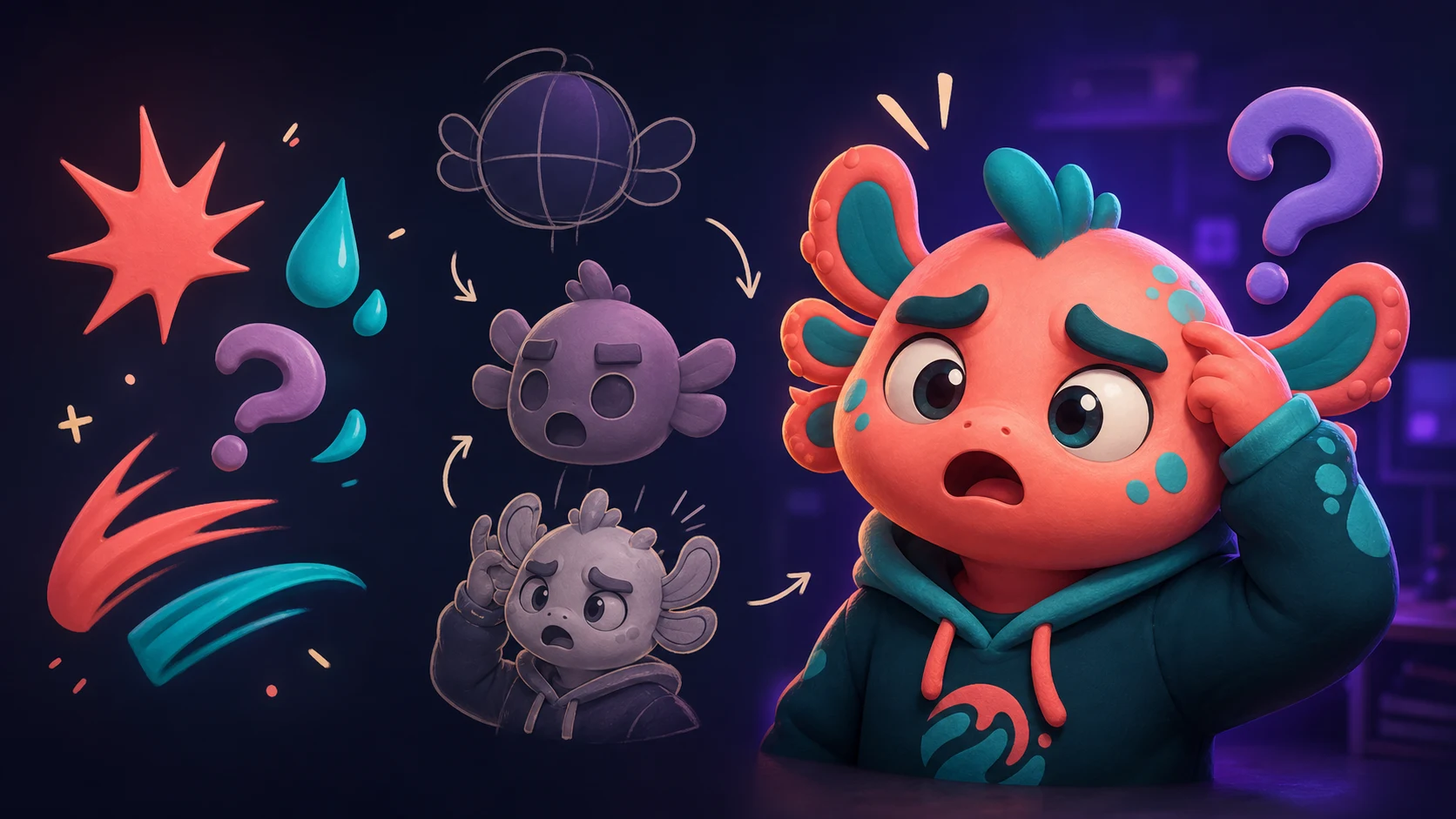
| A familiar confused reaction | The speaker needs another second to understand | Your moth mascot turns its head while one antenna knots around a large question-shaped motion trail |
| A familiar smug reaction | Chat predicted the result and feels vindicated | Your stone golem folds its arms while one eyebrow rises and a tiny trophy tilts behind it |
| A familiar panic reaction | The situation is failing faster than anyone can fix it | Your cloud mascot compresses into a storm ball as two oversized warning sparks orbit it |
| A familiar celebration | An unlikely win deserves an explosive response | Your axolotl mascot leaps through one original burst shape with its fins and hoodie strings forming the silhouette |
Fast originality test
Hide the colors and channel accessories. If viewers still identify somebody else’s character, exact screenshot, costume, or signature pose before they identify your mascot, go back to the brief instead of adding more decoration.
Change the design system, not one cosmetic detail
An original result comes from a chain of independent choices. Start with subject anatomy and silhouette, then choose a different pose, camera angle, prop language, value structure, and motion. Treat color as one decision among many, not as the proof that the work is new.
Your channel already contains better raw material than an imitation: a recurring pet pose, a moderator phrase, a failed-speedrun ritual, a drink cup, a handmade mascot, or the expression you make before saying a catchphrase. Combining those elements creates a reaction that viewers can associate with you.
- Subject: use your own mascot, photo, pet, or artwork you have permission to adapt.
- Silhouette: change the head-to-body ratio, ears or fins, limb position, and outer contour.
- Face: design original eye shapes, brow rhythm, mouth, and cheek marks instead of tracing landmarks.
- Pose: choose a new line of action and camera angle; do not preserve a screenshot’s staging.
- Props: use channel-specific objects rather than another character’s costume, weapon, emblem, or signature accessory.
- Motion: invent a loop that belongs to the reaction, such as an antenna knot, hoodie-string snap, or mascot squash.
Run a rights check before the polish pass
Twitch says creators should upload only emotes for which they have the necessary rights. Its guidance specifically warns about third-party media, other creators’ art or photos, names and logos, and another person’s likeness when used without permission. Emotes can also travel globally across Twitch, so a private channel joke does not stay private in use.
Record where every important ingredient came from. For your own mascot, keep the source drawing and date. For commissioned work, keep the written license or assignment and confirm whether it permits emotes, animation, edits, commercial channel use, and use by another animator. For stock or public-domain material, save the exact license or provenance you relied on.
Do not treat attribution, “fan art,” noncommercial intent, or a disclaimer as automatic permission. Fair use is a case-specific legal doctrine rather than a drawing recipe, and the Copyright Office says there is no preset amount of a work that is always safe to use.
| Ingredient | Evidence to keep | Question to resolve |
|---|---|---|
| Your original character | Layered source, dated sketch, or original photo | Did every visible element originate in your own work? |
| Commissioned mascot | Written terms and artist invoice | Do the granted rights cover emotes, animation, modification, and channel promotion? |
| Licensed asset | License text, receipt, asset URL, and access date | Does the license allow this platform, commercial use, and derivative artwork? |
| Real person | Written consent where appropriate | Do you have the necessary rights to use the person’s likeness in this context? |
Make originality survive the 28-pixel test
Small-chat readability and originality are separate tests. A heavily detailed redesign can still collapse into the same famous silhouette at 28 pixels. Conversely, an original mascot can become unreadable if its expression depends on tiny pupils, a detailed background, or several props.
Reduce the draft to 28 pixels on dark and light chat. Look first at the outer contour, then the eyes and mouth, then one supporting gesture. The viewer should read both the reaction and your channel subject without recognizing a borrowed costume or pose.
| At chat size | Prefer | Avoid |
|---|---|---|
| Silhouette | One original head or upper-body contour | A famous outline hidden under different colors |
| Expression | Oversized brows, eyes, and mouth designed for your mascot | Tracing the precise landmarks of a reaction screenshot |
| Context | One large channel-specific gesture or prop | Background scenes, captions, and several tiny references |
| Edge | Clean transparent boundary that survives both themes | A cropped screenshot rectangle or noisy halo |
Animate the emotion, not somebody else’s scene
Animation is another adaptation choice, not a reset button. Recreating a recognizable scene frame by frame can preserve more of the borrowed expression, even if the final file is small. Begin from the verb in your own brief: recoil, deflate, freeze, squint, celebrate, or melt.
Build one short action around your mascot’s anatomy. Let fins flutter, a cloud rain on itself, or a stone mascot crack and reassemble. Hold the strongest readable pose long enough for chat to understand it, and make the first frame useful as a thumbnail. Check Twitch’s current GIF, file-size, frame-count, and flashing requirements before upload.
A useful stopping rule
If you need to place the inspiration beside the draft to prove the joke works, the emote is probably still dependent on the source. A channel-native reaction should make sense from its trigger, expression, and name on its own.
A practical workflow from meme impulse to original emote
Step 1
Write the chat trigger
Describe the exact stream moment and what the viewer means in one sentence. Remove every franchise, character, creator, and meme name from that sentence.
Step 2
Choose material you control
Start from your own mascot, creator photo, pet, or properly licensed art. Confirm adaptation, animation, commercial, and platform rights before production.
Step 3
Make three unrelated thumbnails
Vary silhouette, camera angle, pose, and prop across three grayscale sketches. Do not keep the original image open as a tracing or composition guide.
Step 4
Select the channel-native concept
Choose the version that regular viewers connect to your stream. Remove accessories, shapes, and gestures whose only purpose is recalling somebody else’s character.
Step 5
Test reaction and identity at 28 pixels
Preview on dark and light chat beside a username. Ask testers what emotion and subject they see without telling them the inspiration.
Step 6
Document and export
Save source files, rights records, final transparent exports, and the brief. Recheck Twitch’s current emote and community guidance before uploading.
Make your first version free
Prototype an original reaction free
Start with art you control, test a channel-native reaction at tiny size, and keep the useful meme timing without copying a recognizable character.
Prototype an original reaction freeRelated MakeEmoji guides and tools
Sources checked
- Twitch: Emote Formatting & Instant Emote Upload Requirements
- Twitch Safety Center: Community Guidelines
- U.S. Copyright Office: What Is Copyright?
- U.S. Copyright Office: Fair Use FAQ
- U.S. Copyright Office: What Visual and Graphic Artists Should Know
Frequently asked questions
How much do I need to change a meme character to make it original?
There is no dependable percentage-change rule. The U.S. Copyright Office says you cannot claim another person’s work merely because you changed it without the owner’s consent. Start from an independently created subject and composition rather than measuring cosmetic changes. Ask a lawyer about a specific high-stakes design.
Is crediting the original artist enough for a Twitch emote?
No. Attribution and permission are different. Keep evidence that you own the material or have rights that cover the intended emote, animation, modification, and platform use.
Can I use a meme pose with my own mascot?
A broad emotion or communication idea can inspire an original brief, but avoid reproducing a distinctive composition, costume, prop, pose, or other recognizable creative expression. Build several thumbnails from the reaction job and choose a channel-native design.
Does this workflow guarantee Twitch approval or avoid infringement?
No. Twitch can review or remove emotes, and legal outcomes depend on specific facts and applicable law. This workflow reduces copying risk through independent creative choices, but it is not legal advice or a guarantee.