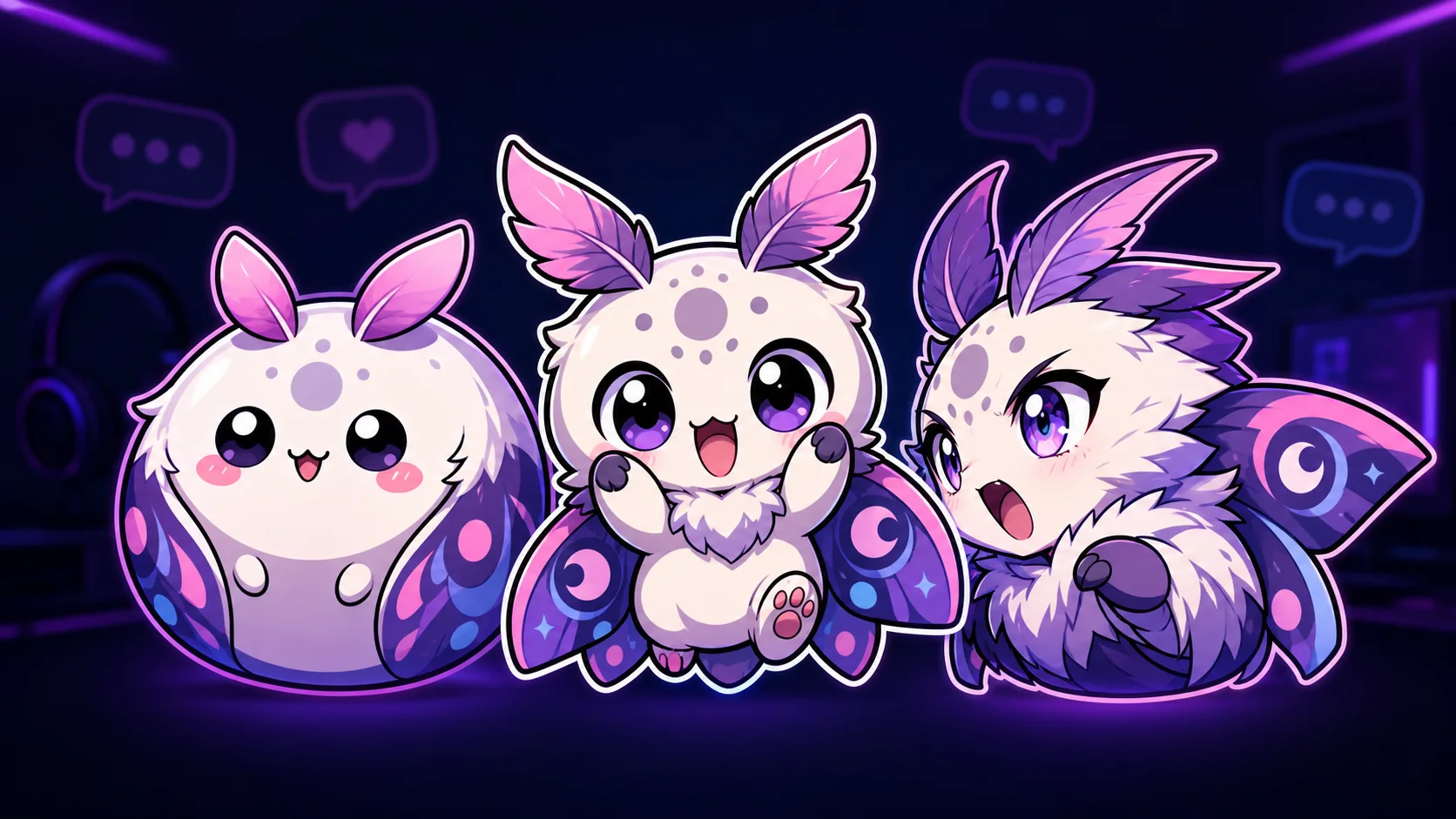
Kawaii vs Chibi vs Anime Twitch Emotes: Which Style Fits Your Stream?
Compare kawaii, chibi, and anime-inspired emote styles by proportion, expression, detail, consistency, and readability in live chat.
Short answer
Choose by readability and channel identity, not by a supposed best style. Kawaii emotes emphasize simple cute shapes, chibi emotes use exaggerated small-body proportions, and anime-inspired emotes borrow a broader expressive drawing vocabulary. Those categories overlap. Test the same reaction in each direction at 28 pixels, then pick the version viewers understand fastest and that your artist can repeat consistently across a full pack.
Last reviewed: 2026-08-02
Style labels are useful for briefing an artist, but they are not rigid scientific categories. A chibi character can also look kawaii, and an anime-inspired face can use chibi proportions. Treat the words as a shared vocabulary for shape, proportion, detail, and expression—not as evidence that one look performs better in chat.
The practical goal is a reaction system. Your hello, laugh, shock, love, loss, and hype emotes should feel related, stay legible beside chat text, and still resemble your stream at a glance. Start with the reaction your viewers already type most often and compare styles using that same subject and emotion.
What kawaii, chibi, and anime-inspired mean in an emote brief
These descriptions focus on visible construction choices. They do not rank artistic quality, popularity, or cultural authenticity. Use them to tell a designer what to simplify and what must survive at chat size.
| Direction | Working definition | Useful strength | 28px risk |
|---|---|---|---|
| Kawaii | A cute visual direction built from rounded silhouettes, compact features, soft expressions, and minimal detail. | Very simple faces can remain clear in fast chat. | Several emotions may look alike if only the mouth changes. |
| Chibi | A proportion system with an oversized head, reduced body, and intentionally exaggerated pose or expression. | Body language can add personality without a realistic full figure. | Tiny hands, props, and clothing details can disappear. |
| Anime-inspired | A broad direction using graphic eyes, expressive brows, hair shapes, impact marks, or dramatic reaction framing. | Strong facial acting suits shock, rage, focus, and triumph. | Fine linework and eye highlights can collapse into noise. |
Important overlap
“Kawaii” usually describes a cute quality, “chibi” mainly describes stylized proportions, and “anime-inspired” covers many visual conventions. A single emote may honestly fit all three. Your brief should name concrete traits instead of asking for a label alone.
Pick the direction from the job the emote must do
Use the table as a starting hypothesis, then test with your own viewers. There is no platform-wide dataset showing that one of these style labels wins. The best evidence is whether people identify and use the reaction in your channel.
| Channel need | Good first direction | Why | Brief the artist to preserve |
|---|---|---|---|
| Cozy greetings and reassurance | Kawaii or kawaii-chibi | A compact rounded face keeps the emotional signal gentle and immediate. | One bold mouth shape, open silhouette, dark outline. |
| Mascot acting and recurring bits | Chibi | The small body can carry poses, costumes, and channel-specific gestures. | Head-first readability; one prop at most. |
| Competitive shock, focus, or victory | Anime-inspired or anime-chibi | Sharper brows and impact shapes can clarify a high-intensity reaction. | Large face, restrained highlights, clean outer contour. |
| A mixed variety channel | Hybrid system | Shared colors and outlines can unify different levels of intensity. | Same mascot proportions, palette, and line weight. |
Build a pack, not three unrelated illustrations
Lock a small style sheet before producing every reaction. Consistency comes from repeated decisions, not from applying the same label to each file. Draw a neutral turnaround or reference face, then define the few variables that are allowed to change.
- Choose one outer-line color and one line-weight range for the whole pack.
- Keep the mascot's head shape, eye spacing, signature marking, and core palette fixed.
- Give every emotion a different silhouette: open arms for hype, compressed pose for fear, tilted head for confusion.
- Limit each emote to one focal reaction and, if necessary, one large prop.
- Name files by meaning—hello, laugh, nope, love—not by visual style, so gaps are obvious.
Run the 28-pixel decision test
Export the same candidate reaction as a transparent square and view it at 112, 56, and 28 pixels on both light and dark backgrounds. At 28 pixels, ask someone who did not see the brief what the emote means. If they describe the decoration instead of the emotion, simplify the decoration.
Also place three copies in a mock chat line. Repetition exposes muddy outlines and weak contrast faster than a large art-board preview. Keep the winner based on recognition, resemblance to your channel, and repeatability—not on which full-size drawing contains the most detail.
Simple scoring card
Give each candidate 0–2 points for emotion recognized, mascot recognized, silhouette clear, and pack consistency. Use the score to structure discussion; it is a local design test, not a claim about all Twitch viewers.
When paid polish is worth considering
First prove the direction with one free draft and a small reaction set. A paid commission or premium generation pass makes sense when you have a stable mascot reference, a precise list of expressions, and details that require deliberate redrawing. Paying before the brief is settled usually buys more revisions, not a clearer identity.
A concrete free style-comparison workflow
Step 1
Choose one real chat moment
Pick a frequent reaction such as hello, close win, bad roll, or raid welcome. Write its meaning in one sentence before choosing a visual style.
Step 2
Make three controlled drafts
Use the same mascot, crop, palette, and emotion in kawaii, chibi, and anime-inspired directions. Change only the construction choices you are comparing.
Step 3
Remove nonessential detail
Keep one face, one readable pose, and one signature feature. Replace thin lines and tiny accessories with larger graphic shapes.
Step 4
Preview at Twitch sizes
Check transparent PNG exports at 112, 56, and 28 pixels. Test on light and dark chat-like backgrounds and ask for an unprompted reaction read.
Step 5
Expand only the winning system
Turn the clearest direction into six core reactions. Save colors, outline rules, and mascot proportions in a one-page style sheet before adding niche ideas.
Make your first version free
Make a free Twitch emote draft
Start with one frequent chat reaction, keep the subject centered, and create a square draft you can compare at 28 pixels before committing to a full style.
Make a free Twitch emote draftRelated MakeEmoji guides and tools
Sources checked
Frequently asked questions
Are kawaii and chibi Twitch emotes the same thing?
No. Kawaii generally describes a cute visual quality, while chibi usually describes exaggerated proportions such as a large head and small body. They often overlap, so a chibi emote can also be kawaii.
Do anime-inspired emotes need a full character body?
No. A face or bust is often easier to read at 28 pixels. Use a body only when the pose carries essential meaning, and enlarge the gesture rather than preserving realistic proportions.
Which Twitch emote style gets the most subscribers?
There is no reliable public Twitch dataset that isolates these subjective style labels and proves one drives more subscriptions. Choose from your channel identity and test recognition and actual use in your own community.
Can one Twitch emote pack mix these styles?
Yes, if the mascot, outline, palette, and level of detail remain coherent. A useful hybrid might use kawaii simplicity for calm reactions and more anime-inspired impact shapes for hype while keeping the same face construction.
What should I test before ordering a full emote pack?
Test one common reaction at 28 pixels, on light and dark backgrounds, and beside chat text. Confirm that viewers identify both the emotion and mascot without a prompt, then document the winning construction rules.