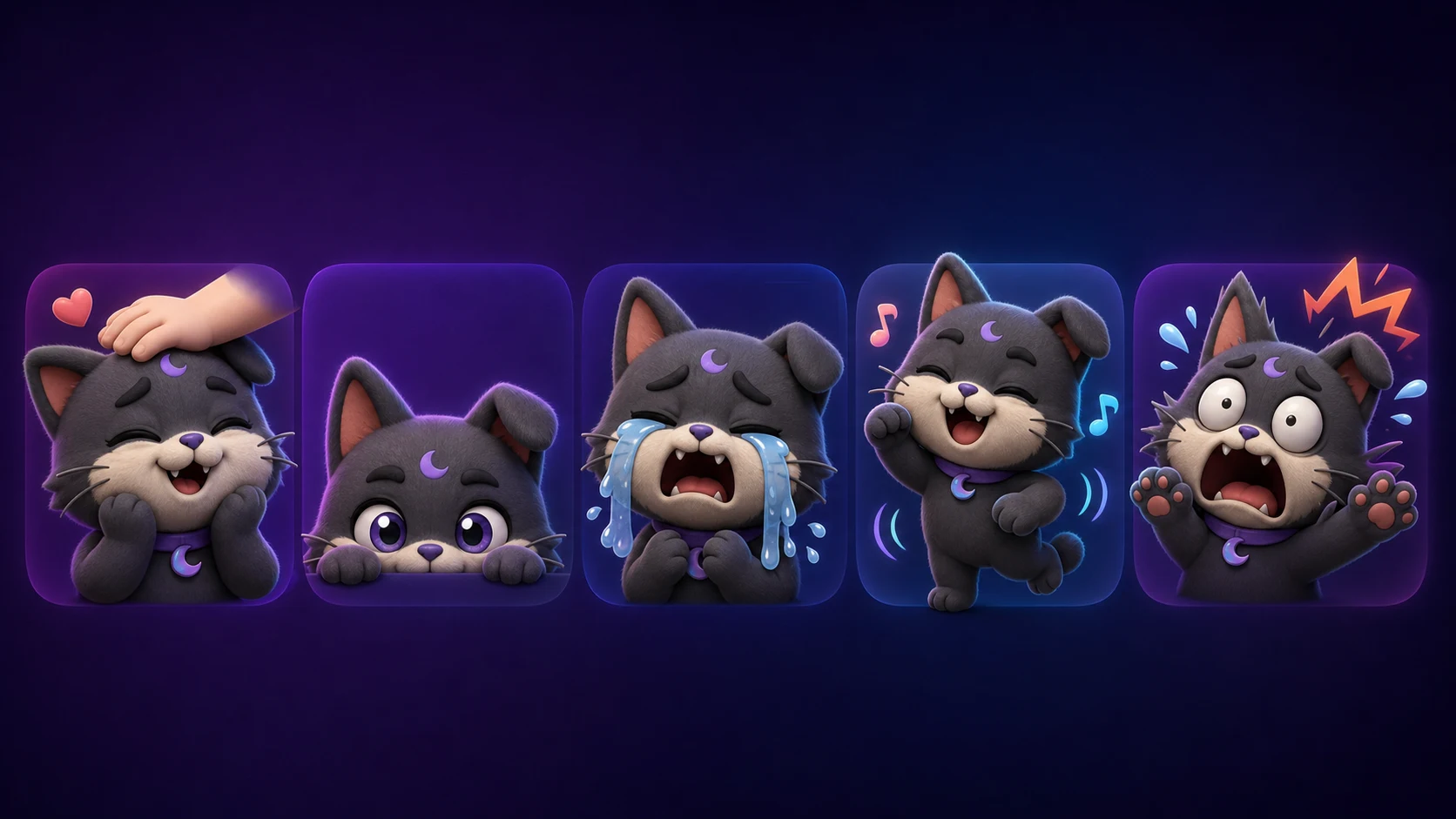
Cat Reaction Emote Pack: Pet, Lurk, Cry, Jam, and Panic
Build five clearly differentiated cat reactions from one original mascot while preserving its face, markings, silhouette, and chat-size readability.
Short answer
A useful first cat reaction pack needs five different chat jobs: Pet for affection or praise, Lurk for quiet support, Cry for sympathy or comic sadness, Jam for music and celebrations, and Panic for mistakes or close calls. Use the same original cat, but give every reaction a different silhouette, expression, and motion. Test static crops first, compare MakeEmoji’s matching effects, and approve each result at 28 pixels.
Last reviewed: 2026-08-03
Cat mascots can cover an unusually wide emotional range without losing their identity. Ears, paws, whiskers, and a compact face produce strong tiny silhouettes, while familiar behaviors—seeking pets, hiding, yowling, bouncing, and startling—map naturally to live chat.
The trap is making five cute cat drawings that all mean ‘happy.’ Build the pack around repeated viewer intentions, keep a small identity kit constant, and exaggerate one different pose for each reaction. MakeEmoji’s Pet, Lurk, Jam, Panic, and related previews let you compare that system on one source before committing to a larger commissioned pack.
The five-emote cat starter pack
These five reactions cover affection, passive support, sadness, celebration, and stress. Together they are more useful than five meme variations with overlapping meanings.
| Emote | When chat uses it | Original cat direction | 28px pass condition |
|---|---|---|---|
| Pet | Good play, comfort, praise, or wholesome moment | Closed happy eyes; one oversized hand pressing the ears gently down | Hand, ears, and pleased face remain separate |
| Lurk | Viewer is present but working, eating, commuting, or resting | Eyes and two paws peek over one simple edge | The gaze reads without a detailed monitor or blanket |
| Cry | Sad story, failed attempt, goodbye, or exaggerated joke | Tight face crop with two large tear streams | Tears do not cover the mouth or outer eye shapes |
| Jam | Music, clean rhythm, celebration, or chat moving together | One paw raised and hips or shoulders rocking | Face holds long enough to remain recognizable |
| Panic | Close call, scuffed setup, jump scare, or technical problem | Asymmetric ears, raised paws, wide eyes, and one bold stress mark | Movement does not blur the eyes into a pale patch |
Pack rule
Keep the mascot consistent and the verbs different: receive affection, hide, grieve, dance, panic. If two thumbnails express the same verb, revise the pose before polishing.
Create a cat identity kit before drawing reactions
Choose three or four large anchors that will survive every crop. Useful anchors include one bent ear, a forehead patch, a thick cheek shape, a specific collar, or two-tone paws. These create recognition without forcing every emote to use the same camera angle.
Record the palette and outline treatment alongside a neutral front-facing drawing. You can enlarge tears, flatten ears, or hide most of the body while preserving the same muzzle, marking, and collar. Avoid copying a recognizable cartoon or meme cat; use a real pet photo you own, an original mascot, or commissioned art with the needed rights.
- Lock one head shape, muzzle shape, eye style, and two or three large markings.
- Use a collar or accessory only if it remains visible at chat size.
- Decide how the ears change with emotion: upright, relaxed, flattened, or asymmetric.
- Keep whiskers bold and sparse; thin whiskers often disappear after downscaling.
- Save a transparent neutral master that can feed several MakeEmoji previews.
Prototype the static meaning before adding motion
Sketch each reaction as a still square. If Pet, Jam, and Panic only become distinguishable after movement, their first frames are too similar. Animation should amplify a readable pose rather than supply all of its meaning.
Place the five thumbnails in one row at 28 pixels. Squint or step back and identify them by silhouette. Pet should have a clear top-down hand, Lurk a low horizontal edge, Cry a face-dominant droplet shape, Jam a strong diagonal pose, and Panic a wide raised-paw contour.
| Problem | Why it happens | Concrete fix |
|---|---|---|
| Every cat looks equally cute | The same smile and front-facing crop were reused | Change ear position, mouth, paws, crop height, and outer contour |
| Lurk looks like a normal portrait | The hiding edge is too small | Raise the edge and show only eyes, ears, and paws |
| Cry becomes a blue blur | Too many small droplets cross the face | Use two large streams outside the eyes and preserve the muzzle |
| Jam and Panic merge in motion | Both use fast whole-body shaking | Give Jam a steady beat and Panic an irregular recoil |
| Dark fur disappears | The outer value matches dark chat | Add a controlled light keyline or brighter rim on lost edges |
Match the MakeEmoji effect to the reaction job
Upload the neutral cat source and compare the catalog effects that correspond to each job. Pet supplies the affectionate action; Lurk supports the peek; Jam establishes rhythm; Panic intensifies the startled pose. For Cry, begin with the clearest sad source expression and compare movement only if it improves the emotion.
Keep the source crop consistent so the five outputs still look like a pack. If a preset changes the mascot so strongly that the marking, ear, or face disappears, select a calmer effect or create a reaction-specific source image. The pack’s identity matters more than using the most dramatic animation every time.
Motion budget
Do not animate all five just because you can. A static Lurk or Cry may be clearer, while Pet, Jam, and Panic gain obvious meaning from movement. Let the reaction choose the format.
Test the pack as a chat system
Give the files short codes that viewers can predict, such as NovaPet, NovaLurk, NovaCry, NovaJam, and NovaPanic. Put them in a mock chat row beside badges and usernames on dark and light themes. Each thumbnail should stay readable alone and in a repeated emote wall.
Launch the core five before building seasonal hats, alternate colors, or increasingly specific expressions. Ask moderators which reactions occur naturally for several streams. The next addition should fill an observed gap—perhaps Hype, Sip, Love, or Bonk—not duplicate the most popular drawing with a slightly different mouth.
Workflow: build the five-reaction cat pack
Step 1
Define the original cat
Choose art you own and record the head, muzzle, ear, marking, collar, outline, and palette anchors that make the mascot recognizable.
Step 2
Sketch five distinct silhouettes
Draw Pet, Lurk, Cry, Jam, and Panic as simple grayscale thumbnails. Revise until each can be identified without color or labels.
Step 3
Prepare readable source crops
Fill the square, preserve padding for ears and paws, simplify thin whiskers, and test the static expressions on dark and light backgrounds.
Step 4
Compare matching animation effects
Preview Pet, Lurk, Jam, Panic, and suitable emotional motion on the same mascot. Keep motion only where it clarifies or strengthens the reaction.
Step 5
Run a live-chat trial
Export compliant files, upload the first five, ask moderators to use the intended codes, and track which missing reaction chat actually requests next.
Make your first version free
Prototype your cat reaction pack
Start with one original cat source, test the core reactions at chat size, and animate only the poses whose meaning improves with movement.
Prototype your cat reaction packRelated MakeEmoji guides and tools
Sources checked
- Twitch: Animated Emotes
- Twitch: Emote Guidelines and format requirements
- Twitch Safety Center: Community Guidelines
- U.S. Copyright Office: What Visual and Graphic Artists Should Know
Frequently asked questions
What five cat emotes should a new streamer make first?
Pet, Lurk, Cry, Jam, and Panic form a balanced starter set because they cover affection, quiet support, sadness, celebration, and stress instead of repeating one mood.
Can I turn a photo of my real cat into Twitch emotes?
Yes, if it is your photo or you have permission to use it. Choose a close, well-lit image with visible ears and face, then simplify the crop and test the result at 28 pixels.
Should all five cat reactions be animated?
Not necessarily. Pet, Jam, and Panic often benefit from motion. Lurk and Cry may be clearer as static reactions. Use animation only when movement adds meaning.
How do I keep the cat recognizable across different poses?
Repeat a few large identity anchors such as the muzzle, one ear shape, a forehead marking, collar, and palette. Let the crop and pose change while those anchors stay consistent.
Can I use a famous meme cat as my channel mascot?
Do not assume an image being popular online makes it free to use. Build from your own pet, original character, licensed asset, or commissioned design with appropriate permission.