Roleplay Streamer Emote Ideas: In Character, OOC, Wanted, Arrested, and Lore
Build an original roleplay reaction vocabulary that separates performer, character, story consequences, and community lore at chat size.
Short answer
A practical roleplay streamer pack separates performance from coordination: In Character marks the scene, OOC signals a real-world aside, Wanted and Arrested react to story consequences, and Lore celebrates a reveal. Use your own character or mascot, exaggerate one theatrical cue per emote, and avoid copied server logos, game UI, uniforms, locations, or characters.
Last reviewed: 2026-08-03
Roleplay chat follows two conversations at once: the fictional scene and the community watching it. A useful pack helps viewers move between those layers without interrupting the performance. In Character and OOC establish context; Wanted, Arrested, and Lore react to consequences and discoveries inside the story.
The emotes should belong to the channel even when a season ends or the character changes jobs. Start from original art you control, then use masks, frames, books, bars, expressions, and color as theatrical shorthand rather than recreating a specific game's world.
The five-emote roleplay starter set
Give each slot one conversational function. The viewer should recognize whether an emote is framing the performance, stepping outside it, or reacting to a plot beat before reading the code.
| Emote | Chat purpose | Original visual direction | Keep distinct with |
|---|---|---|---|
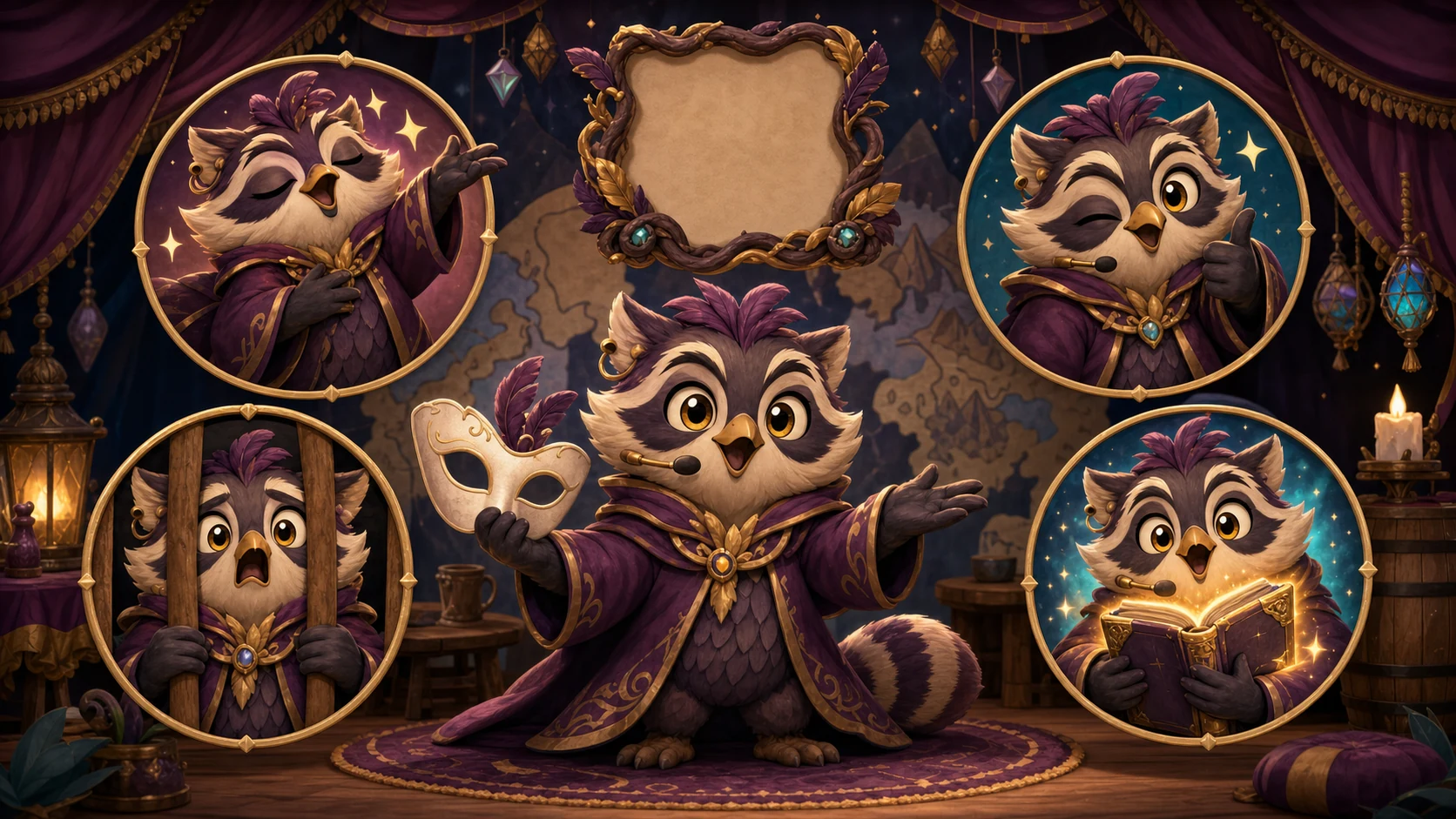
| In Character | A scene begins, an actor commits to the bit, or a dramatic exchange lands | Confident mascot holding one plain theatrical half-mask | Stage pose and warm spotlight |
| OOC | A real-world aside, technical pause, clarification, or creator reaction | Relaxed mascot lowering the mask and giving a friendly wink | Open posture and cool accent color |
| Wanted | A character attracts attention, starts a pursuit, or faces consequences | Nervous face inside an ornate but completely blank portrait frame | Frame silhouette without tiny writing |
| Arrested | A plan collapses, authorities arrive, or chat predicts custody | Comic shocked mascot behind three oversized generic wooden bars | Vertical-bar silhouette and wide eyes |
| Lore | Backstory drops, a mystery connects, or a clue changes the scene | Excited mascot opening a glowing blank book | Book shape, warm glow, and discovery face |
Context test
In Character and OOC must look opposite at a glance. If both are smiling headshots, add the mask-up versus mask-down gesture and separate their color temperatures.
Build a second wave around your story's recurring beats
Generic reactions make the pack usable; recurring channel language makes it memorable. Add a slot only after viewers repeatedly need it, then express it with original props and poses that do not depend on knowledge of a particular server.
- Roll: mascot releasing one oversized abstract die shape without copied tabletop branding.
- Alibi: earnest face holding one blank card close to the chest.
- Suspicious: narrowed side-eye toward one footprint or open doorway.
- Plot Twist: mask flips once as the expression changes from calm to shocked.
- Court: mascot making one formal but fictional bow beneath a simple arch.
- Flashback: a soft spiral frame around a younger, simplified version of the same mascot.
- Canon: mascot carefully placing one glowing story tile into an original book.
Protect identity, privacy, and story boundaries
Use only character art, creator likenesses, references, and commissioned assets you are authorized to turn into emotes. Do not lift another player's avatar, a server logo, police or faction insignia, game screenshots, character portraits, interface panels, or recognizable locations.
Roleplay can involve conflict, but the emote does not need realistic violence or humiliating detail. Wanted can be a blank frame; Arrested can be a surprised mascot behind broad bars. Keep real private information, accusations, and personal disputes out of the art and emote names.
| Story idea | Original shorthand | Leave out |
|---|---|---|
| Wanted | Blank frame, alert eyes, abstract spotlight | Real name, mugshot text, seal, or copied poster |
| Arrested | Three broad bars and comic surprise | Real badge, agency mark, weapon, or graphic harm |
| Lore | Blank glowing book and discovery face | Copied quest text, game symbol, or story screenshot |
| Faction | Channel-owned color and original shape | Server, gang, police, brand, or game insignia |
Make theatrical ideas legible at chat size
A roleplay scene can hold dozens of details; a 28-pixel emote cannot. Crop to the face and upper body, use one oversized prop, and make the emotional cue carry the meaning. Wanted should work as a nervous framed portrait without poster copy. Lore should still read when the book contains no visible writing.
Test the transparent images in dark and light mock chat beside usernames and badges. Ask someone unfamiliar with the episode to sort the five reactions. If the meaning depends on a tiny costume ornament or hidden reference, simplify it.
- Keep masks, frames, bars, and books thick enough to survive reduction.
- Use different mouth and eye shapes for performance, aside, fear, shock, and discovery.
- Avoid long codes; choose a channel prefix plus IC, OOC, Wanted, Arrested, or Lore.
- Check current Twitch content and formatting guidance before upload.
Use animation as a scene change
The strongest roleplay loops have one beat: In Character raises a mask, OOC lowers it, Wanted gets a short spotlight sweep, Arrested closes the bars once, and Lore opens a book to a steady glow. Hold on the readable expression long enough for chat to understand it.
Avoid camera-like flashing, frantic shaking, or a miniature reenactment of the whole scene. The animation should reinforce a static reaction that already passes the tiny-size test. Review Twitch's current animated-emote requirements before creating the delivery files.
A practical roleplay emote workflow
Step 1
Separate chat functions
List the repeated moments that frame the performance, step outside it, and react to plot consequences. Choose one starter emote for each distinct job.
Step 2
Confirm the art you control
Collect your original mascot or authorized character references and write an avoid list covering other characters, logos, uniforms, game UI, and locations.
Step 3
Sketch prop-sized silhouettes
Draw the mask, blank frame, broad bars, and blank book as large shapes around the same face. Remove any object that only reads when zoomed in.
Step 4
Run an outsider sorting test
Show the five 28-pixel reactions without their codes to someone who did not watch the episode. Fix any meaning that requires lore to explain.
Step 5
Animate one transition
After the static set works, choose one mask, bar, spotlight, or book motion. Keep the expression stable and verify current platform requirements before upload.
Make your first version free
Make a free roleplay emote
Start with one original In Character, OOC, Wanted, Arrested, or Lore reaction and prove that its face and prop read outside the episode context.
Make a free roleplay emoteRelated MakeEmoji guides and tools
Sources checked
- Twitch: Emote Guidelines and formatting requirements
- Twitch: Animated Emotes
- Twitch Safety Center: Community Guidelines
Frequently asked questions
Which roleplay streamer emotes should I make first?
Start with In Character, OOC, Wanted, Arrested, and Lore. They frame the performance and cover several common story consequences without depending on one episode.
How can viewers tell In Character from OOC?
Use opposite gestures and color cues. In Character can raise a mask under warm stage light; OOC can lower it with a relaxed posture and cooler accent.
Can I use my game character or roleplay server logo?
Use only art and branding you own or are authorized to adapt. An original mascot and generic theatrical props avoid relying on another game, server, faction, or player's protected visual identity.
Does an Arrested emote need a police badge or uniform?
No. Three broad generic bars and a comic surprised expression communicate the consequence more clearly at 28 pixels and avoid copying a real or fictional agency mark.