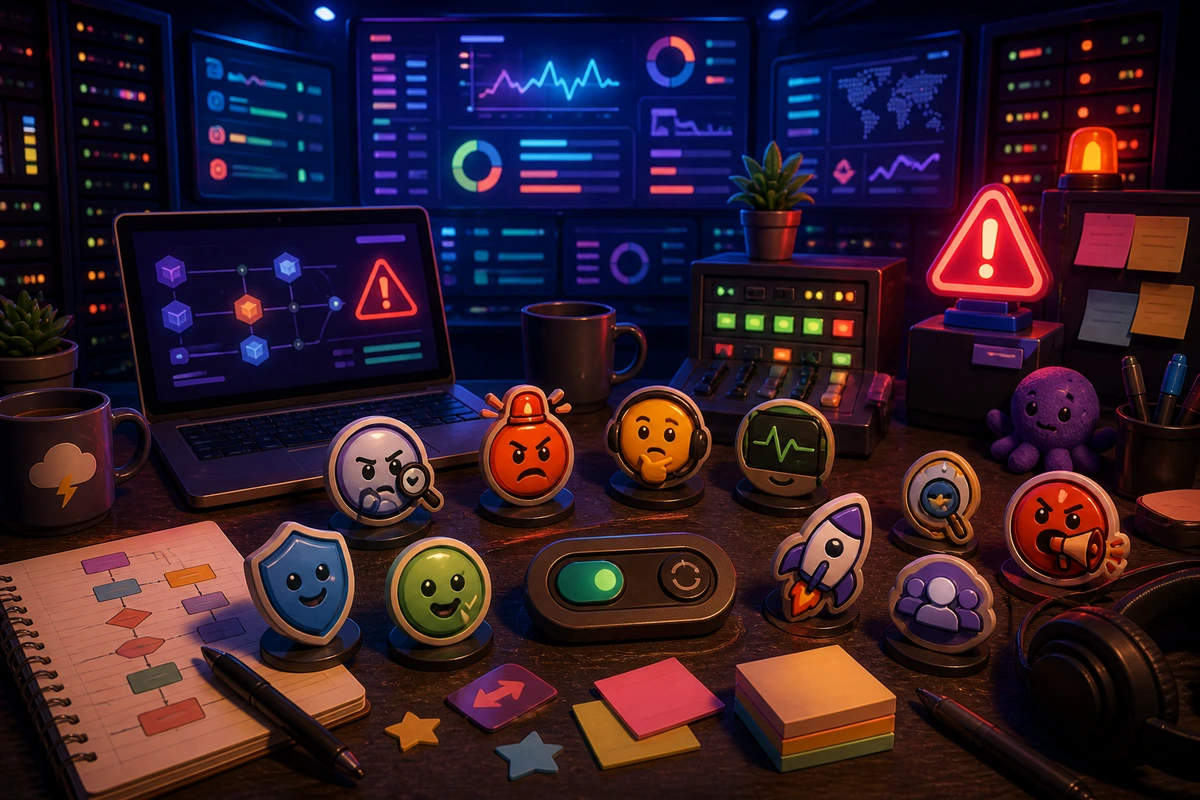
DevOps Incident Response Emoji Pack
Standardize Slack incident reactions for investigating, mitigating, rollback, monitoring, resolved, and postmortem moments.
Short answer
A DevOps incident response emoji pack should be planned around repeatable chat moments, not decorative filler. Start with Investigating reaction., Mitigating reaction., Resolved reaction., Needs owner reaction., then add niche reactions only after the first set is getting used. Use clear status symbols and restrained motion so incident channels stay readable during stressful moments.
Who this is for
This guide is for engineering teams, SREs, incident commanders, DevOps managers, and Slack workspace admins.
Recommended starter set
Investigating reaction.
Mitigating reaction.
Resolved reaction.
Needs owner reaction.
Rollback reaction.
Postmortem reaction.
Workflow
Step 1
Choose the real moments
Mirror the incident lifecycle: detected, investigating, owner assigned, mitigation, monitoring, resolved, and follow-up. A smaller set tied to repeated behavior will outperform a large set of pretty reactions that nobody remembers to use.
Step 2
Create a shared visual rule
Use clear status symbols and restrained motion so incident channels stay readable during stressful moments. Keep one crop, outline weight, palette, and background approach so the pack feels intentional.
Step 3
Launch with usable names
Use exact operational terms so reacji searches and channel norms stay consistent. Upload a first set, announce the names, and watch what people actually use before expanding.
Quality checklist
- Choose reactions that map to real Slack moments.
- Keep the subject large enough to read at chat size.
- Use one naming convention across the whole pack.
- Export a static fallback for any important animated reaction.
- Prefer clarity over humor for anything used during a live incident.
Common mistakes
- Making the pack too broad before the first Slack upload.
- Letting tiny details carry the meaning.
- Using names only the creator understands.
- Skipping a final grid review before upload.
- Using jokes that make incidents feel less serious.
- Creating too many similar red-alert reactions.
- Animating status icons so aggressively that they distract.
Next steps
FAQ
What should be in a devops incident response emoji pack?
Start with Investigating reaction., Mitigating reaction., Resolved reaction., Needs owner reaction.. Those cover the moments people are most likely to repeat. Add niche reactions only when the core set is already being used.
Should a devops incident response emoji pack use animation?
Use animation for incident live, rollback, monitoring, and resolved signals. Keep status, moderation, and text-heavy reactions static unless motion makes the meaning clearer.
How do I get people to use the pack?
Use exact operational terms so reacji searches and channel norms stay consistent. Announce the pack with the exact names, model the reactions in real conversations, and remove weak items after a usage review.