Shared Chat Emote Ideas for Collabs, Raids, and Co-Streams
Create collaboration reactions that remain legible across communities and understand what changes between Shared Chat, raids, and co-streams.
Short answer
Build a collaboration emote set around moments both communities can understand: hello, team-up, your-turn, shared win, friendly rivalry, raid arrival, technical pause, and goodbye. Keep each creator recognizable with one color or mascot cue, test every design at 28 pixels, and coordinate names before going live. MakeEmoji can help create and export the artwork, but Shared Chat, raids, co-stream permissions, moderation, and emote access are controlled by Twitch and the participating channels.
Last reviewed: 2026-08-03
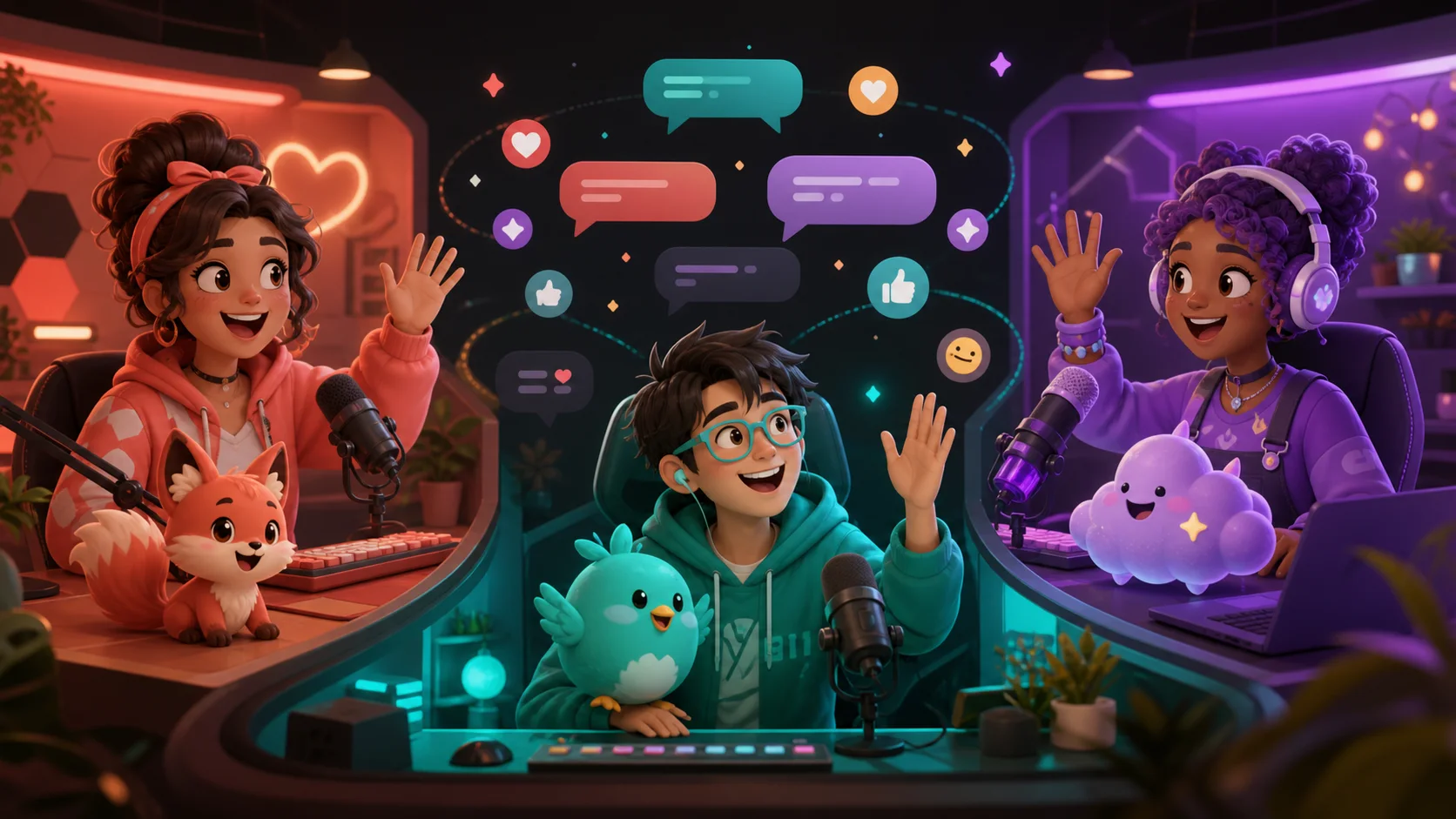
A collaboration pack works when someone arriving from either channel understands it immediately. That is a different design problem from making another private in-joke for your regulars. During a joint show, chat needs a visual vocabulary for introductions, handoffs, combined wins, rivalry, confusion, and the moment everyone heads to the next channel.
Twitch currently describes Shared Chat as a Stream Together feature that combines participating communities' messages into one chat experience. It is not the same action as a raid, and official co-streaming has its own permission and setup rules. Plan the artwork around the viewer moments those tools create, but keep the platform operations separate from the image-making workflow.
Shared Chat, raids, and co-streams create different emote moments
Shared Chat is useful while multiple creators are live together: messages from participating communities appear in the combined chat, and viewers can see which community a chatter came from. A raid happens at the end of a broadcast and sends the connected audience to another channel. Twitch's official co-streaming feature is for an allowlisted main broadcast that grants permission for other creators to rebroadcast the event with their own commentary.
Those distinctions should shape the pack. A Shared Chat set needs turn-taking and team reactions. A raid set needs an unmistakable arrival and welcome. An official event co-stream benefits from prediction, analysis, upset, and score reactions that do not copy the event's protected logos or broadcast art.
| Moment | Viewer job | Useful original emote |
|---|---|---|
| Shared Chat begins | Acknowledge both communities | Two original mascots high-five inside one bold silhouette |
| Creator handoff | Signal whose turn it is | Mascot points left or right with a large open palm |
| Combined win | Celebrate the group result | Both mascots lift one shared trophy-shaped prop |
| Raid arrival | Enter the destination chat together | Compact marching or doorway entrance pose |
| Official event co-stream | React to the event without copying it | Original mascot gasp, prediction, analysis, or upset reaction |
| Collab ends | Close the shared moment warmly | Two-character wave or split heart |
Three tools, three different jobs
Do not use raid, Shared Chat, Stream Together, and co-stream as interchangeable labels. Twitch controls those features and their eligibility, moderation, permissions, and session behavior. MakeEmoji creates image and animation files; it does not start a Shared Chat, authorize a co-stream, upload to collaborators' channels, or move viewers between channels.
Start with eight reactions both communities can use
The best first set covers the collaboration arc from arrival to exit. Give every reaction one job and make the pose legible without the emote code. If a design only makes sense after explaining a three-year channel joke, keep it in the home-channel set rather than the collaboration set.
A paired-mascot design can be memorable, but it is not required. Face-led creators can use matching color bands, mirrored poses, or one simple connector shape. The goal is to signal that the moment belongs to the collaboration while keeping each creator's identity visible.
- CollabHi: a two-character wave or one mascot opening a door for the other.
- TeamUp: a high-five, fist bump, linked controllers, or shared microphone.
- YourTurn: a strong pointing pose for handoffs, guesses, and challenges.
- WeWon: both mascots support one oversized celebratory prop.
- FriendlyTilt: mock rivalry with playful eyebrows, not hostility or harassment.
- RaidIn: a marching, parachuting, doorway, or rocket entrance with a compact silhouette.
- TechPause: one clear loading, cable, or worried-headset reaction for interruptions.
- CollabBye: a paired wave, split heart, or two mascots walking off together.
Keep both channel identities readable at 28 pixels
Two characters inside one square can become a pile of tiny facial features. Assign each creator one recognition anchor that survives reduction: a large ear shape, bright fringe, simple hat, cheek patch, or dominant color block. Put those anchors on opposite sides of the square and let one shared gesture connect them.
Avoid dividing the image with a thin vertical line or miniature labels. At chat size, the line looks accidental and the names disappear. Use pose direction, color masses, and silhouette instead. Preview the result on charcoal and pale backgrounds, then remove details until the intended reaction reads before either face is inspected closely.
| Design problem | What fails | Stronger replacement |
|---|---|---|
| Two full-body characters | Faces become unreadable dots | Crop both around one shared hand or prop |
| Two channel names | Tiny lettering turns into noise | Use one color and one silhouette cue per creator |
| Several inside jokes | New viewers cannot infer the meaning | Choose one universal action such as wave, point, or celebrate |
| Matching low-contrast palettes | The characters merge together | Separate the dominant value and outline of each side |
| Constant looping motion | The pair becomes visual noise | Animate one shared beat, then return to a readable pose |
Coordinate codes, moderation, and ownership before the show
Treat the files as shared production assets, even if each final upload remains associated with a particular channel. Decide who owns the source art, which channels may use it, whether either creator can reuse a solo crop later, and how long a limited-event design stays active. If an artist made the pack, make sure the written license covers both creators and any edits or animation you expect to make.
Twitch says Shared Chat is jointly moderated during the session, while each channel's own chat modes and moderation settings still apply to messages from its community. Other channels' third-party applications may also be able to read and act on Shared Chat data. That is a moderation and tooling review for the collaborators—not something the emote artwork can solve.
- Agree on exact codes, capitalization, and who announces them before going live.
- Keep codes short and distinct enough to find quickly during a fast collab.
- Document source-art ownership, channel usage rights, edit rights, and retirement date.
- Brief both mod teams on the shared session and test bots or overlays separately.
- Never assume one creator's upload, subscription, cheer, poll, prediction, or Power-Up automatically transfers to every participating channel.
Design a coordinated set, not a fake integration
You can export matching files and agree on matching codes. That does not synchronize emote slots, permissions, revenue, moderation settings, or channel events. Confirm every Twitch feature in Creator Dashboard and the current official help page before the live collaboration.
Animate one shared action instead of both characters at once
Motion is most useful when it explains the collaboration: hands meet for one high-five, a baton crosses from one mascot to the other, two halves of a heart connect, or the raid group enters through one doorway. Keep the first frame readable because viewers may disable animation and the file will appear small in a moving chat.
Build the static composition first, then animate the connecting action. If both characters bounce, blink, spin, and throw particles at the same time, the viewer sees activity but loses the message. Review Twitch's current animated-emote requirements at export because formats and limits can change.
| Reaction | One useful motion | Static fallback |
|---|---|---|
| TeamUp | Hands meet once | Hands nearly touching |
| YourTurn | Baton crosses the center | Clear pointing pose |
| RaidIn | Group enters from one edge | Forward marching silhouette |
| TechPause | One cable reconnects | Worried mascot holding plug |
| CollabBye | Heart halves join, then settle | Completed heart between mascots |
Workflow: prepare a collaboration emote kit
Step 1
Map the live collaboration
Write the actual sequence: introductions, game or activity, handoffs, shared wins, possible technical breaks, raid, and sign-off.
Step 2
Choose eight viewer jobs
Give each reaction one purpose. Remove private references that a visitor from the other community cannot decode.
Step 3
Lock one anchor per creator
Choose a large color or silhouette cue for each channel and one shared gesture that connects the pair.
Step 4
Make the static masters
Compose tight square reactions, test at 28 pixels on dark and light backgrounds, and simplify before animating.
Step 5
Agree on rights and codes
Record ownership, allowed channels, edit permission, exact codes, upload responsibility, and whether the set is permanent or event-only.
Step 6
Test Twitch separately
Each creator verifies uploads, access, Shared Chat, moderation, bots, and the raid or co-stream plan in Twitch's own tools before the event.
Make your first version free
Make one collaboration emote free
Start with one original face, mascot, or properly licensed joint illustration. Build a TeamUp, RaidIn, or CollabBye reaction, test it at chat size, and download the file before expanding the full set.
Make one collaboration emote freeRelated MakeEmoji guides and tools
Sources checked
- Twitch: Shared Chat
- Twitch: How to Use Raids
- Twitch: Co-Streaming on Twitch
- Twitch: Introducing Shared Viewership
- Twitch: Animated Emotes
Frequently asked questions
Does Shared Chat combine every channel's emote library?
Do not assume that. Twitch documents Shared Chat as a combined chat experience, but emote access and channel entitlements remain platform-controlled. Confirm what each test account can use in the live session instead of treating a coordinated art set as a synchronized library.
Is a raid the same as Shared Chat?
No. Twitch describes a raid as sending the viewers connected to your chat to another channel, usually when your stream ends. Shared Chat combines messages among participating live communities inside a Stream Together collaboration.
Can we upload the same collaboration emote to two channels?
Only when both channels have the necessary rights and each upload follows Twitch's current rules. Put both-channel usage, edits, animation, attribution, and future reuse in writing with the artist or rights holder.
Does MakeEmoji start Shared Chat or upload to every collaborator?
No. MakeEmoji helps turn source artwork into downloadable image or animation files. Twitch and the participating channel owners control Shared Chat, Stream Together, raids, official co-stream permissions, moderation, uploads, and viewer access.