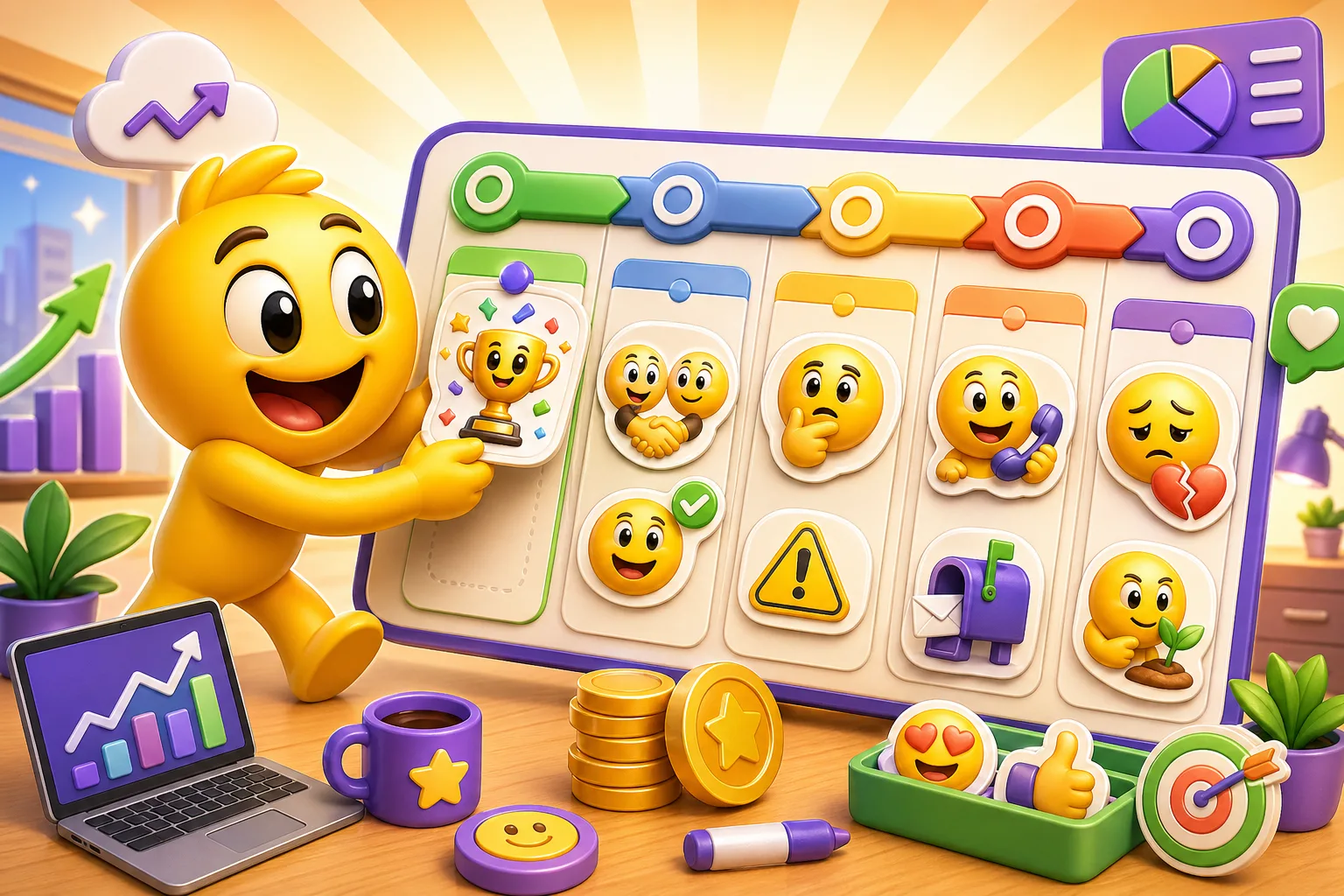
Sales Team Reaction Emojis (Deal Stages, Wins, Losses)
Custom emoji pack for sales teams: pipeline stages, win celebrations, deal tracking, and more.
Your sales team's Slack has 47 channels and 200 messages about deals every day. Someone asks "what stage is the Acme deal?" and three people check the CRM before answering. Another asks "did we close that enterprise deal?" and the answer is buried in a celebration thread from yesterday. Standard emojis don't capture sales pipeline nuance. A targeted custom emoji system turns deal updates into visual workflow that the entire team reads instantly.
Pipeline stage emojis are the foundation
New lead emoji marks the start of the pipeline. A fresh face icon, a "NEW" badge, or an incoming arrow signals a lead just entered your system. This gets used constantly—every time someone qualifies a new lead, the emoji goes in Slack. Over time, scrolling through your deals channel shows the flow of new business entering your pipeline. Name it :new_lead: for instant recognition.
Qualified lead versus disqualified needs visual distinction. A green checkmark or thumbs up for qualified, red X or thumbs down for disqualified. Sales teams qualify dozens of leads weekly. The emoji provides instant yes/no clarity without reading paragraphs of qualification notes. Managers can scan the channel and see qualification ratios at a glance. High disqualification rate? Visible immediately through emoji density.
Opportunity stage progression uses sequential emojis. Discovery gets one icon (magnifying glass), demo scheduled gets another (presentation screen), proposal sent gets a third (document), negotiation gets a fourth (handshake). These create a visual pipeline in chat. When someone posts about a deal, the stage emoji immediately contextualizes where it is in the process. New reps learn pipeline stages by seeing emoji usage.
Contract sent and verbal commitment need separate markers. Verbal commitment feels like a win but isn't official yet. A handshake emoji or "VERBAL" badge shows you're close but not closed. Contract sent uses a document or signature icon showing the deal is in legal/admin phase. This distinction prevents premature celebration while still acknowledging progress toward closure.
Win celebration tiers match deal significance
Small wins deserve acknowledgment without over-celebration. A single trophy, thumbs up, or checkmark for deals under your small deal threshold. These happen frequently and keep momentum going. Everyone uses this emoji—it's the everyday win marker. Quick, simple, positive reinforcement for closed business regardless of size.
Medium wins get escalated celebration. Multiple trophies, party popper, or celebration emoji for deals in your core range. These are the bread and butter of your business. They warrant more excitement than small wins but aren't rare enough to be extraordinary. This tier gets the most use in healthy sales teams—consistent medium wins mean steady business.
Large wins trigger team-wide celebration. Fireworks, massive trophy, or "HUGE WIN" badge for deals above your large threshold. These happen monthly or quarterly depending on your business. The emoji signals everyone to pile on congratulations. These wins move team metrics significantly. The celebration intensity matches the business impact.
Mega deals are rare and deserve special recognition. A unique emoji reserved only for the biggest deals—top 5% of your annual revenue. Custom design featuring your company logo or mascot celebrating. This emoji appears a few times per year maximum. Its rarity makes its appearance special. Seeing this emoji means someone did something extraordinary. The whole company notices.
Activity tracking shows daily progress
Outreach completion emojis track daily activity. Email sent (envelope), call completed (phone), meeting scheduled (calendar)—these mark the actions that fill pipelines. Some teams post daily activity summaries with these emojis showing what everyone accomplished. Managers see activity levels at a glance. Low emoji counts mean low activity.
Response indicators show prospect engagement. Positive response gets a green checkmark or smiley, negative response gets a red X or frown, no response gets a question mark or ghost. This immediate feedback helps team members know how prospects are reacting. Lots of no-response emojis? Maybe your outreach needs work. Mostly positive responses? Your messaging resonates.
Follow-up needed markers prevent deals from falling through cracks. A clock, reminder bell, or "FOLLOW UP" badge tags deals requiring action. This emoji appears when prospects respond positively but no next step is scheduled yet. It's the "don't forget about this" indicator. Helps everyone remember which deals need immediate attention versus which are waiting on external factors.
Objection raised emoji signals challenges without detail. A caution sign, roadblock, or hurdle icon shows a deal hit an obstacle. This prompts team members to offer help or advice. The emoji doesn't explain the objection—that goes in text. But it makes the challenge visible so support can be mobilized. Objections are normal; marking them prevents them from becoming silent deal-killers.
Deal health indicators for pipeline visibility
Green/healthy deal emoji shows everything tracking well. A green circle, checkmark, or thumbs up indicates the deal is progressing on schedule with no red flags. These make up most of your pipeline in a healthy quarter. Managers doing pipeline reviews see mostly green emojis when forecasts are solid. The absence of green emojis is an early warning signal.
Yellow/at-risk markers flag potential problems early. A yellow caution sign or warning triangle shows a deal needs attention but isn't dead yet. Maybe timeline slipped, budget questions emerged, or decision maker changed. Yellow emojis trigger manager check-ins: "What support do you need to get this back to green?" Early intervention saves deals.
Red/critical status demands immediate action. A red alert, fire emoji, or "HELP" badge indicates a deal is dying without intervention. These should be rare—if half your deals are red, you have bigger problems. Red emoji triggers all-hands response: senior team involvement, executive engagement, creative solutions. It's the sales equivalent of code red.
Stalled emoji marks deals stuck without clear next steps. A stop sign, pause symbol, or frozen icon shows forward momentum stopped. Different from "at risk"—the deal isn't necessarily dying, but it's not moving. Maybe waiting on internal approvals, evaluating competitors, or budget timing. Stalled deals need different strategies than at-risk deals. The distinction helps prioritize approaches.
Forecast confidence levels
Commit emoji indicates highest confidence. A locked-in icon or "COMMIT" badge marks deals you're willing to stake your forecast on. These should be 90%+ probability in your judgment. Managers roll these up to leadership as guaranteed revenue. The commit emoji carries weight—using it inappropriately damages credibility. Only commit-tagged deals count toward team commitments.
Best case markers show likely-but-not-certain deals. A rising chart or "LIKELY" badge indicates 60-80% confidence. These could close or could slip. They're in forecast but above the commit line. Smart managers track best-case coverage—if you need 100 in commits but only have 80, you need 30+ in best case to feel safe about hitting quota.
Pipeline emoji marks earlier-stage opportunities. A funnel icon or "PIPELINE" badge shows deals that could close but have lower probability. Maybe 30-50% confidence. These fill your pipeline coverage and provide upside potential. Pipeline deals becoming best case becoming commits is healthy progression. Track conversion rates between these tiers.
Long shot or upside emoji indicates low-probability deals worth tracking. A lottery ticket or "UPSIDE" badge marks deals that could be huge but probably won't close this quarter. Maybe 10-20% probability. These don't count in forecasts but provide context for future quarters. Some teams skip this tier entirely. Others like tracking upside for motivation and future planning.
Team coordination and territory management
Account ownership markers clarify responsibility. "My deal" versus "team deal" versus "unassigned" prevents confusion about who owns what. A person icon with different colors or labels shows ownership at a glance. This matters when deals get reassigned, territories change, or accounts need coverage. Clear ownership prevents both duplication and neglect.
Handoff needed emoji signals territory transfers. When a deal moves from SDR to AE, from AE to account manager, or from one region to another, the handoff emoji marks the transition. This creates accountability—both parties know the handoff is happening. Track handoff-tagged deals to ensure nothing falls through during transitions.
Support request emojis get help fast. "Need manager" (manager icon), "pricing approval" (dollar sign with question mark), "technical question" (tech icon), "legal review" (scales of justice)—these specific requests let people know exactly what support is needed. Much faster than typing "hey can someone help with this deal?" The emoji specifies the help required.
Executive sponsor needed marker escalates appropriately. A crown, executive icon, or "C-LEVEL" badge indicates a deal needs senior involvement. This isn't everyday escalation—it's for strategic accounts or deals where executive relationships matter. The emoji ensures the request doesn't get buried in channel noise. Executives can filter for this emoji to see where their involvement is requested.
Customer sentiment and engagement
Enthusiasm levels gauge buyer interest. "Very interested" (multiple fire emojis), "interested" (thumbs up), "lukewarm" (neutral face), "skeptical" (thinking face), "not interested" (X). These subjective assessments help team members understand buyer temperature without reading full call notes. Enthusiasm declining over time? Deal might be cooling. Enthusiasm increasing? Momentum building.
Champion identified emoji marks your internal advocate. A superhero cape, star, or "CHAMPION" badge shows you have someone inside the organization championing your solution. Champions dramatically increase win rates. Tracking which deals have champions versus which don't helps prioritize where to build relationships. Deals without champions need more work finding advocates.
Decision maker engaged marker shows access to power. A key icon or "DM ENGAGED" badge indicates you're talking to the person who signs the contract. Many deals stall because reps work with influencers not decision makers. This emoji makes decision maker engagement visible. Managers reviewing pipeline can immediately see which deals have decision maker access and which need to climb higher.
Blocker present emoji warns of opposition. A stop sign, roadblock, or "BLOCKER" badge indicates someone internal to the prospect is resisting your solution. Blockers kill deals silently if not addressed. Marking them prompts team discussion: "How do we neutralize or work around the blocker?" Ignoring blockers hoping they go away rarely works. Addressing them explicitly does.
Competitive situation markers
No competition emoji is the dream scenario. A solo trophy, "SOLO" badge, or greenfield icon shows you're the only option being evaluated. These deals move faster and close at higher rates. Tracking what percentage of your pipeline has no competition helps understand your market position. More solo deals mean better market fit or targeting.
Competition present markers change strategy. One competitor (1st place ribbon), two competitors (2nd place), three or more (3rd place or "CROWDED" badge). More competition means longer sales cycles, more pricing pressure, more differentiation needed. The emoji helps set realistic expectations and allocate resources—solo deals need less time than competitive bake-offs.
Positioning indicators show where you stand. Leading (1st place medal), tied (equal sign), behind (upward arrow showing comeback potential), unknown position (question mark). These subjective assessments guide strategy. Leading? Maintain advantage and close. Behind? Differentiate or disqualify. Tied? Create separation. Unknown? Discovery needed.
Incumbent advantage or disadvantage matters. If you're the incumbent being evaluated against competitors, a crown or "INCUMBENT" badge shows you have advantage. If you're the challenger, a challenger icon or "CHALLENGER" badge changes strategy—you need to prove switching cost is worth it. The incumbent/challenger distinction fundamentally changes your approach.
Product and solution tracking
Product line indicators show what's being sold. If you sell multiple products, each needs an emoji: Product A, Product B, Product C. This helps segment pipeline by product line. Marketing can see which products generate most leads. Sales leadership can compare product performance. Individual reps can focus on products they know best. Product emojis create instant categorization.
Tier level markers show deal complexity. Enterprise tier (building icon), professional tier (briefcase), starter tier (seedling). Different tiers have different sales processes, pricing, and resources. The emoji lets everyone know what kind of deal this is without checking detailed notes. Enterprise deals need executive involvement and custom contracts. Starter deals might be self-serve.
Add-on or upsell emoji distinguishes expansion from new business. A plus sign, growth arrow, or "UPSELL" badge shows this deal is expanding an existing customer. Upsells typically close faster and at higher rates than new business. Tracking new versus expansion revenue is critical for SaaS businesses. The emoji makes this distinction visible in every deal discussion.
Implementation complexity affects close timeline and resources. Quick start (lightning bolt), standard implementation (normal pace), complex deployment (warning for long timeline), migration needed (moving boxes). Implementation complexity impacts customer success resourcing, technical team involvement, and timeline to value. The emoji helps set expectations.
Internal approval and documentation
Awaiting approval emoji marks deals in internal process. A clock, hourglass, or "PENDING" badge shows the deal is waiting on internal sign-off—pricing approval, legal review, executive approval, whatever your process requires. This removes ambiguity about why a deal isn't progressing. It's not the customer, it's internal process. These deals need internal follow-up, not customer outreach.
Approved emoji clears deals for progression. A green stamp, "APPROVED" badge, or checkmark signals internal hurdles are cleared. Now the rep can proceed confidently. Tracking approval time helps optimize internal processes. If deals sit in "awaiting approval" status for weeks, your internal process is bottlenecking sales. Make it visible with emojis and fix the underlying problem.
Documentation status shows deal readiness. Proposal ready (document icon), contract ready (signature icon), fully executed (completed contract). These administrative markers help operations team track what needs preparation. Sales reps can see which deals have necessary paperwork ready versus which need to be created. Documentation delays kill momentum—tracking them with emojis helps prevent delays.
Naming conventions for sales emojis
Use sales terminology your team already speaks. If you call early pipeline "leads," use :lead_new:. If you call them "prospects," use :prospect_new:. Match your existing vocabulary. Don't invent new terms just for emojis—that adds unnecessary learning curve. The emoji system should feel natural to your team's existing language.
Pipeline stage prefixes create logical grouping. All lead-stage emojis start with lead_, all opportunity-stage start with opp_, all deal-stage start with deal_. When someone types :lead, they see all lead-related emojis. This organization helps people find the right emoji fast without memorizing dozens of unrelated names.
Action and status descriptors should be obvious. :deal_won:, :deal_lost:, :opp_stalled:, :lead_qualified:—the name tells you exactly what it means. No clever abbreviations, no inside jokes. Sales teams are busy. They need emoji names that are instantly understandable without consulting documentation.
Integration with CRM and automation
CRM webhook integrations auto-post deal updates with emojis. When a deal moves to "Proposal Sent" stage in Salesforce, automatically post to Slack with the proposal emoji. When a deal closes, auto-post with the appropriate win celebration emoji based on deal size. This removes manual posting while maintaining emoji-based visibility. The team sees pipeline activity without anyone having to remember to post updates.
Slack workflows can trigger on emoji reactions. When someone reacts to a deal post with the "need help" emoji, trigger a workflow that @mentions the manager and creates a task in your project management system. When someone uses the "won" emoji, trigger celebratory GIF and update the team dashboard. Emojis become interactive buttons for automated actions.
Dashboard visualization of emoji-tagged deals provides leadership visibility. Pull Slack messages with specific emojis into executive dashboards. How many deals are marked "at risk"? How many are "commit" level? What's the trend in "new lead" emojis over time? The emoji data becomes business intelligence. Leadership gets real-time pipeline visibility without manual reporting.
Building team culture around celebrations
Emoji-based celebrations scale naturally. In a 5-person sales team, typing "Congratulations on the win!" for every deal works. In a 50-person sales org, it becomes overwhelming. Emoji reactions let everyone celebrate without flooding channels. Quick emoji reaction shows support without requiring composed messages. This maintains celebration culture as teams grow.
Different celebration tiers prevent fatigue. If you celebrate every small deal with fireworks and all-caps excitement, big wins have nowhere to go. Tiered celebration emojis let you match energy to deal significance. Small wins get thumbs up. Medium wins get trophy. Large wins get party poppers. Mega deals get the special emoji. The escalation keeps celebrations meaningful.
Loss markers normalize losing as part of sales. Having a "deal lost" emoji makes it okay to acknowledge losses. Some teams add "lessons learned" or "next time" emojis that reframe losses as learning opportunities. Healthy sales culture acknowledges that losing is part of the job. Emoji-based loss tracking removes shame while maintaining visibility into what's not working.
Shared visibility creates accountability and motivation. When everyone sees pipeline progression through emoji markers, individuals feel accountable to keep deals moving. When everyone sees win celebrations, it motivates others. The emoji system makes individual activity part of team rhythm. You're not selling alone—your progress is team progress. The visibility drives both accountability and support.
Sales team emoji systems transform pipeline communication from buried CRM data into visible team workflow. Start with pipeline stages and win celebrations, add deal health indicators and forecast confidence levels, then expand to activity tracking and team coordination. Integrate with CRM for automated updates, use clear naming conventions, and build celebration culture that scales. Create your sales team emoji pack here →