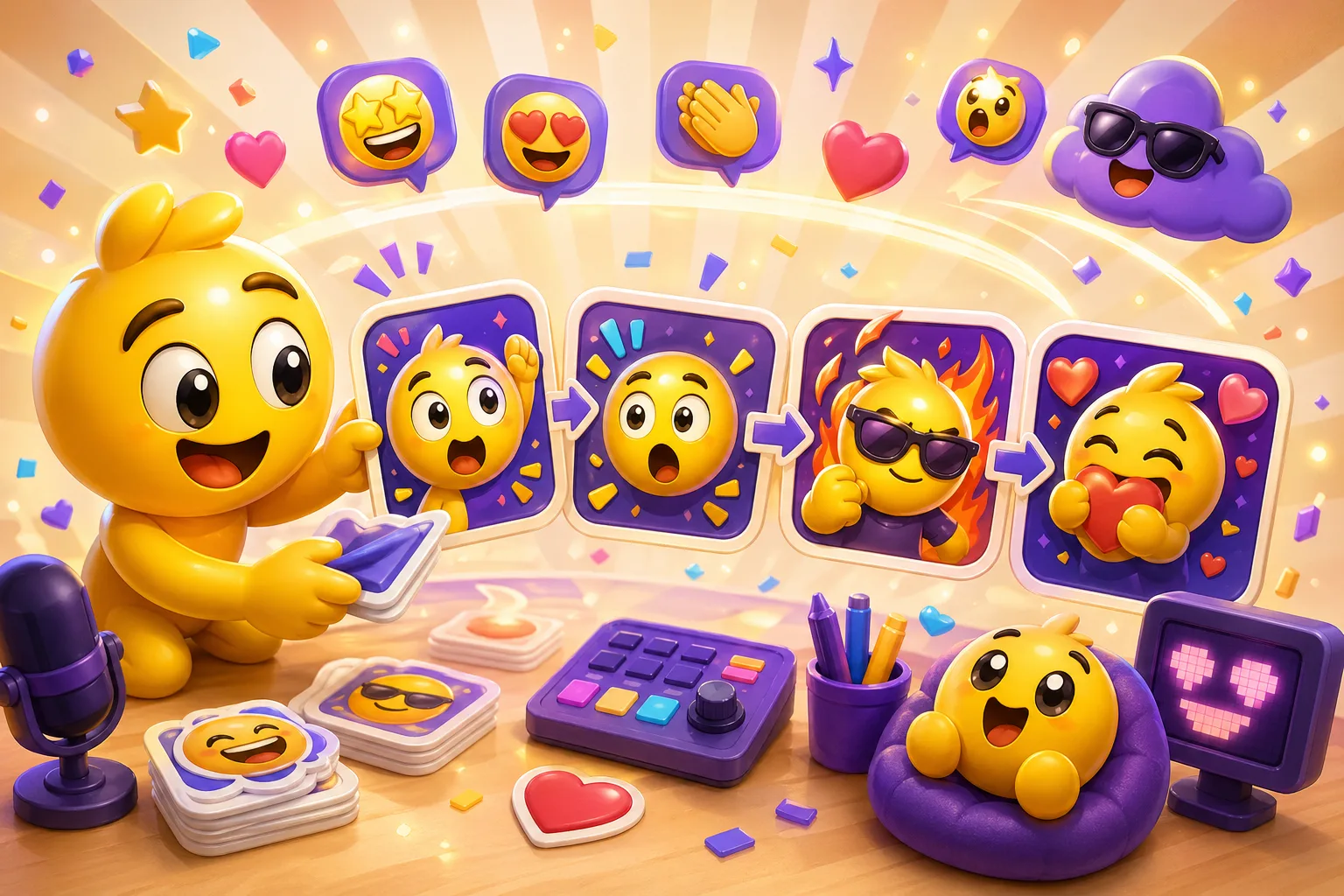
Emote-Only Mode: Creating Emojis That Tell a Story
Design emoji sets that work in emote-only chat mode where viewers communicate entirely through emojis.
Your Twitch stream enables emote-only mode. Suddenly, text is gone. Your chat can only communicate through emojis. That emoji you thought was "obviously happy" gets used for sadness because people interpret it differently without text context. The emoji that worked fine when people could type "lol" alongside it fails when standing alone. Emote-only mode exposes which emojis actually communicate clearly and which only work with text support.
What changes in emote-only mode
Emojis become the entire language, not decoration. In normal chat, people type "that's so funny 😂" and the emoji reinforces the text. In emote-only mode, there's just the emoji. It must carry the complete message. If your emoji only makes sense with text context, it fails. This fundamental shift requires designing emojis differently—they need to be self-contained communication units.
Ambiguous emojis cause confusion rather than mild uncertainty. When people can type clarifications, ambiguous emojis get explained. In emote-only mode, there's no clarification. An emoji that could mean three different things creates actual communication failure. Viewers can't ask "wait, what did you mean?" They can only respond with another emoji, potentially compounding the confusion.
Coverage gaps become immediately obvious. Missing a key emotional response in normal chat? People type it. Missing it in emote-only mode? That emotion can't be expressed at all. If your emoji set lacks "confused" or "disagree" or "thinking," entire categories of responses disappear. The gaps that seemed minor become communication dead zones.
Sequences and combinations replace sentences. People learn to use multiple emojis in sequence to create meaning. Sad emoji + question emoji = "why sad?" Happy emoji + celebration emoji = "really excited!" These patterns emerge naturally but only if your emoji set has the building blocks. The set needs to work both individually and compositionally.
Essential emoji categories you must have
Basic agreement/disagreement is non-negotiable. Yes, no, agree, disagree, maybe—without these, people can't respond to questions or statements. A simple checkmark for yes, X for no, and question mark for maybe covers fundamental response needs. These get used constantly. If you only have 10 emoji slots, these take three of them. They're that important.
Core emotional reactions need full coverage. Happy, sad, angry, surprised, confused, scared—the basic emotions humans express. Each needs a clear, unambiguous emoji. These aren't optional "nice to haves." They're the vocabulary of emotional response. Without them, emote-only communication feels robotic and limited. People need to express how they feel, not just agree or disagree.
Laughter and humor markers separate entertainment from other positive reactions. "Happy" and "laughing" aren't the same. Happy is passive contentment, laughing is active amusement. LOL, LMAO, the crying-laughing face—these communicate "that was funny" which is one of the most common chat responses. Comedy streams especially need multiple levels of laughter from "mildly amusing" to "can't breathe."
Thinking/processing indicators show engagement without commitment. A thinking emoji or "hmm" reaction says "I'm considering this" without agreeing or disagreeing yet. This is crucial for discussions. People need to show they're thinking about something without immediately responding yes or no. It's the emote equivalent of "let me think about that."
Celebration and support emojis keep positive energy flowing. Applause, celebration, party popper, trophy—these let viewers hype up the streamer or each other. Gaming streams especially need these for wins and achievements. The communal celebration is part of the experience. Without celebration emojis, victories feel muted even in emote-only mode.
Design principles for clarity without text
Exaggerate expressions beyond what seems necessary. That "slightly happy" emoji reads as neutral in emote-only mode. That "kind of sad" emoji looks indifferent. Push emotions further. Big smile, wide eyes, clear tears. Subtle expression requires text to interpret—without text, subtle becomes invisible. Over-communicate the emotion in the design itself. This isn't cartoon exaggeration for style, it's functional necessity.
Use universally recognized symbols and gestures. Thumbs up means yes/good across cultures. Thumbs down means no/bad. Heart means love. These symbols transcend language because they're culturally ingrained. Inside jokes and references require shared context that new viewers don't have. Stick to basics that work for everyone, everywhere. Universal clarity beats clever obscurity.
Make each emoji visually distinct from all others. Two different happy emojis that look similar? People will confuse them in emote-only mode. Can't tell your "excited" from your "happy"? They'll use them interchangeably. Every emoji needs a unique silhouette and color scheme. Test by showing just silhouettes—can you tell which is which? If not, they're too similar.
Add text labels directly to emojis when appropriate. "YES," "NO," "GG," "HYPE"—text within the emoji itself removes ambiguity. This works especially well for status markers and specific responses. The emoji becomes a button with a label. Obviously you can't explain complex emotions with text labels, but for simple responses, internal text eliminates guessing.
Building comprehensive emotional coverage
Positive emotions need multiple intensity levels. Slightly pleased, happy, very happy, ecstatic—these are different responses to different situations. Winning a match gets ecstatic. Streamer says something nice gets happy. Chat notices something cute gets slightly pleased. Without intensity variation, all positive responses feel the same. You lose emotional nuance.
Negative emotions require similar range. Disappointed isn't the same as devastated. Annoyed isn't the same as enraged. Worried isn't the same as terrified. Each negative emotion has mild, moderate, and extreme versions. This lets people respond appropriately to the situation's severity. Bad play gets disappointed. Tragic story gets devastated. The intensity matches the context.
Neutral/thinking states bridge positive and negative. Confused, curious, skeptical, contemplative—these aren't positive or negative, they're processing states. "I don't understand" is different from "I disagree." "I'm thinking about this" is different from "I'm bored." Neutral emojis handle the space between emotional extremes where a lot of communication actually happens.
Love and affection emojis strengthen community bonds. Heart, hug, love, support—these express connection between community members. When someone shares something personal, when streamer talks about struggles, when chat wants to show appreciation—love emojis create emotional safety. Toxic communities lack these. Healthy communities use them constantly.
Action and functional emojis
Greeting and farewell emojis mark arrivals and departures. Wave for hello, wave for goodbye—context from timing determines meaning. Or separate hi/bye emojis if you have slots. These social lubricants matter in communities. People want to acknowledge when they arrive or leave. In emote-only mode, the greeting emoji becomes the only way to do this.
Question and answer emojis facilitate actual dialogue. Question mark for asking, exclamation point or lightbulb for answering. People can ask questions and signal answers even without text. Combined with other emojis, these create basic Q&A: question mark + confused emoji = "I'm confused, help?" Answer emoji + checkmark = "yes, that's correct."
Attention and alert emojis focus everyone on something important. Eyes, attention symbol, alert—these say "look at this" or "pay attention." When streamer does something noteworthy, when chat notices something, attention emojis direct focus. In fast-moving emote-only chat, these highlight what matters among the noise.
Food, drink, and casual emojis keep chat conversational. Coffee, pizza, beer—these let people be casual and social. "Taking a snack break" can be communicated with food emoji. "Cheers to that" uses drink emoji. Not every emoji needs to be high-stakes emotional expression. Casual social emojis make emote-only mode feel less restrictive.
Testing emoji clarity
The no-text test reveals which emojis actually work. Look at your chat history, remove all text, leave only emojis. Can you follow the conversation? Can you tell what people were responding to? If the emoji-only version is incomprehensible, your emojis rely too heavily on text context. Redesign for standalone clarity. What seemed obvious with text might be ambiguous alone.
New user testing catches insider assumptions. Show your emoji set to someone unfamiliar with your community. Can they guess what each emoji means? Do they interpret them correctly? Your inside joke emojis that are "so obvious" to regulars confuse newcomers. For emote-only mode to work, new viewers need to understand emojis without learning a secret code first.
Actual emote-only mode practice exposes gaps immediately. Enable emote-only for 10-15 minutes. Watch what happens. Do people struggle to express certain reactions? Do they use emojis in unexpected ways because they lack the emoji they need? Do conversations break down? Real usage reveals problems theory misses. The gaps become obvious when people can't work around them with text.
Cross-cultural testing prevents accidental miscommunication. Gestures and symbols mean different things in different cultures. Thumbs up is positive in most places but offensive in some. OK hand gesture has different meanings. Colors have cultural associations. If your community is international, test emojis with people from different backgrounds. Universal clarity requires universal testing.
Coverage versus complexity balance
Minimum viable set is around 20-30 emojis. Basic yes/no, core emotions, laughter, a few actions. This covers most communication needs without overwhelming new users. People can learn 20-30 emojis quickly. They'll understand what's available and how to use it. Start here. If emote-only mode works with this foundation, expand. If it doesn't, fix the foundation before adding more.
Full-featured sets run 50-100 emojis for maximum nuance. Multiple intensity levels for each emotion, specific situational responses, community inside jokes, game-specific reactions. This allows incredibly detailed communication—almost conversational. But it requires community investment in learning the system. Works for dedicated communities, overwhelming for casual viewers.
Finding your community's sweet spot requires iteration. Start minimal. Track which emojis get used constantly versus rarely. Add emojis that fill communication gaps people keep hitting. Remove emojis that sit unused. Let usage data guide expansion. Your community might need 30 emojis or 80 emojis depending on how they communicate and what your content is.
Category balance matters more than total count. Better to have 3 emotions, 3 actions, 3 status markers, 3 celebrations (12 total, good balance) than 10 slightly different happy emojis and nothing else (10 total, terrible balance). Coverage across categories enables varied communication. Coverage within one category just adds confusion.
Platform-specific considerations
Twitch emote-only mode is a moderator tool for spam control. It gets enabled during hype moments, raids, or when chat gets unruly. Your emoji set needs to handle high-energy situations since that's when emote-only activates. Celebration, hype, excitement emojis get heavy use. Quiet contemplative emojis less so. Design for the chaos.
Global emotes supplement your custom set. Viewers can use Twitch global emotes (Kappa, PogChamp, etc.) plus BTTV/7TV/FFZ emotes even in emote-only mode. This fills some gaps. You don't need to recreate everything that global emotes cover. Focus your custom emojis on what's unique to your community or missing from globals.
Discord emote-only channels are often intentional restrictions. Some servers create emote-only channels for specific purposes: meme channels, reaction channels, chaos channels. These are designed to be emote-only permanently, not temporarily. This changes requirements—you need even more comprehensive coverage since text is never an option.
Subscriber-only emote-only mode creates exclusivity. Some streamers make emote-only mode subscriber-only—subs can chat, everyone else gets emote-only. This incentivizes subscriptions but also means your emoji set needs to work for viewers who can't subscribe. Free emojis need enough coverage that non-subs can still participate meaningfully.
Common failures and how to avoid them
Abstract or artistic emojis fail without text explanation. That beautiful metaphorical emoji representing "the duality of success"? Nobody knows what it means in emote-only mode. They need "happy" or "conflicted" and they need it obviously. Save artistic expression for contexts where text can explain. In emote-only mode, clarity beats creativity every time.
Inside jokes without visual clarity exclude newcomers. Your community understands that weird emoji refers to that one stream moment. New viewers have no context. They see a confusing emoji and can't ask what it means. Inside jokes work in emote-only mode only if the visual itself is clear, with the inside joke being an additional layer for regulars.
Too many similar emojis create decision paralysis. Five slightly different happy emojis? People can't decide which to use in the 0.5-second window they have to respond. They pick randomly or give up. Three clearly distinct happiness levels (mild, moderate, extreme) work. Five subtle variations don't. Distinct beats subtle in fast-paced emote-only chat.
Gaps in basic coverage frustrate everyone. You have 47 celebration emojis but no "disagree"? People trying to express disagreement have nothing. They either stay silent or use inappropriate emojis that confuse the situation. Cover basics first, add personality second. An boring complete emoji set works better than an interesting incomplete one.
Emoji naming for discoverability
Use the emotion or action as the primary name. :happy:, :sad:, :laugh:, :celebrate:—obvious names people try first. Don't be clever with naming in emote-only contexts. :vibe: could mean anything. :happy: means exactly one thing. Predictable naming reduces the learning curve.
Add intensity to name for variations. :happy:, :very_happy:, :super_happy: makes the hierarchy obvious. Or :happy1:, :happy2:, :happy3: for simpler discovery. People typing :happy see all variants. They can choose intensity based on situation. Consistent naming patterns help people find the right emoji fast.
Short names type faster in emote-only mode. :gg: beats :good_game: when you're typing rapidly. :lol: beats :laughing_out_loud:. Emote-only mode means people type more emojis per message. Shorter names let them communicate faster. But don't sacrifice clarity for brevity—:h: for happy is too short to be discoverable.
Evolution based on usage
Track which emojis get used during emote-only mode specifically. Some emojis work great with text but fail alone. Usage stats during emote-only sessions show which emojis actually carry communication weight. Low-usage emojis during emote-only are candidates for removal or redesign. High-usage emojis might need intensity variations if people overuse one emoji for multiple purposes.
Watch for improvised combinations that emerge. People invent emoji sentences: question mark + sad emoji = "why sad?" If this pattern emerges consistently, maybe you need a "concerned" or "sympathetic" emoji that combines both meanings. User-invented patterns reveal gaps in your emoji set. They're making do with what they have. Give them what they're trying to express.
Seasonal adjustment for emote-only mode availability. If you only use emote-only mode during hype moments, your emoji set needs hype-focused coverage. If you use it during chill study streams, different coverage requirements. The context where emote-only activates determines which emojis matter. Design for actual usage contexts, not theoretical scenarios.
Community feedback from emote-only sessions is direct and valuable. People tell you immediately when they can't express something. "We need a 'disagree' emoji" comes up fast when disagreement happens and nobody has a way to express it. These requests are prioritized additions. If multiple people request the same emoji, that's a clear gap needing immediate filling.
Making emote-only mode fun rather than limiting
Frame it as a game or challenge, not a restriction. "Emote-only mode activated, let's see how well you can communicate!" versus "text chat disabled for spam control" creates different energy. The first makes it a creative constraint, the second makes it punishment. Your emoji set should support the game framing—make communication possible and even fun without text.
Unique or clever emojis encourage experimentation. If every emoji is generic (standard happy, standard sad), emote-only mode feels boring. If some emojis have personality—your community's specific inside jokes, streamer references, unique art style—people enjoy using them. The limitation becomes an opportunity to showcase your community's unique emoji culture.
Create emoji-only events or segments intentionally. "Emote-only guessing game," "communicate a story using only emojis," "describe this scene without text." When people practice emote-only communication in fun contexts, they get better at it. Then when emote-only mode gets enabled for practical reasons (spam control), they're already fluent.
Celebrate creative emoji usage. When someone communicates something complex using emoji combinations, acknowledge it. Feature creative emoji conversations. This validates emote-only communication as skill rather than limitation. People try harder and get more creative when emoji-only mode becomes a showcase for communication creativity.
Emote-only mode requires emojis that communicate clearly without text support. Design for exaggerated expressions, comprehensive emotional coverage, and universal clarity. Start with 20-30 essential emojis covering agreement, core emotions, actions, and celebrations. Test by removing all text—if conversations still make sense, your emojis work. Add intensity variations and community-specific emojis based on usage patterns. Create emote-only mode ready emojis here →