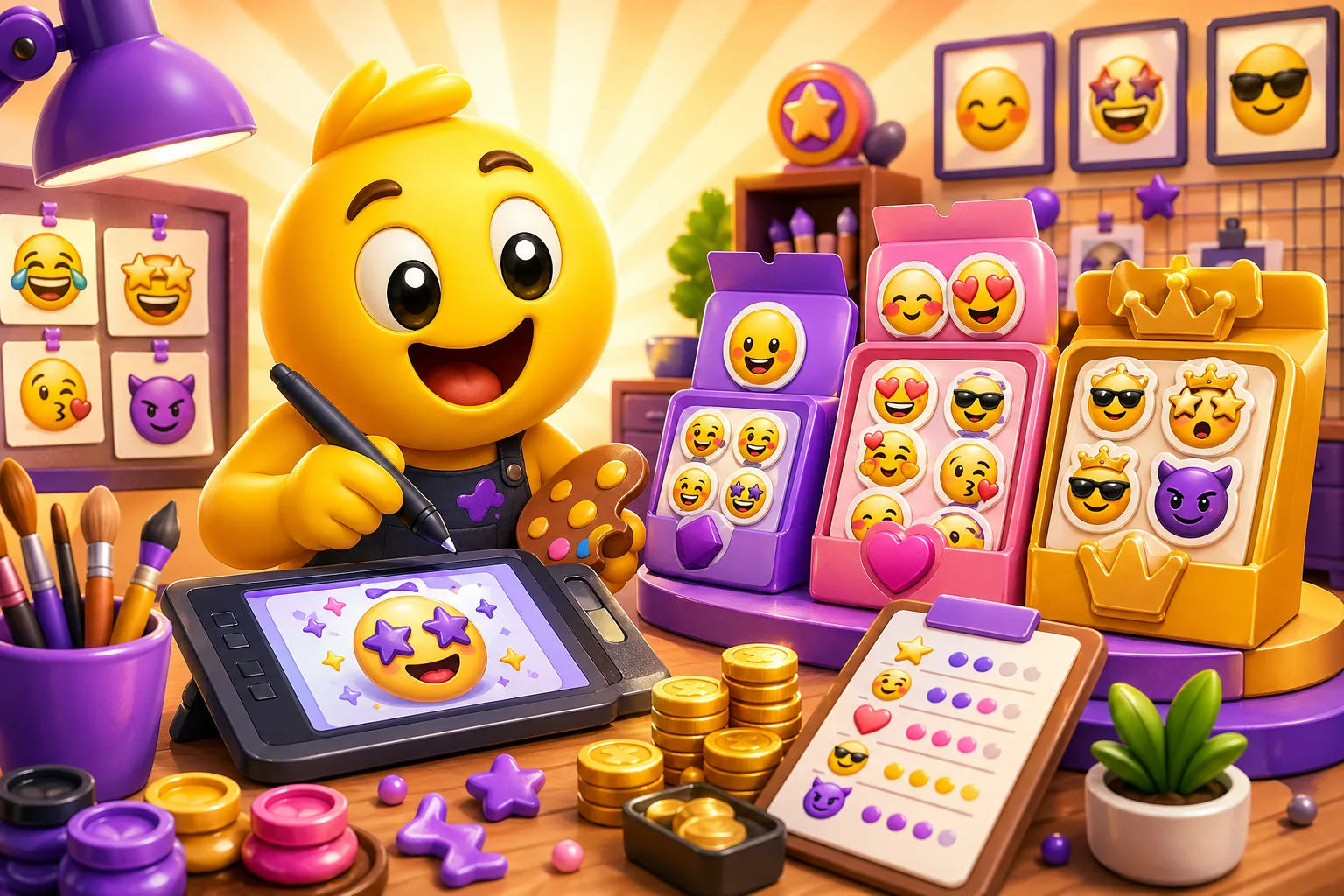
Emoji Commissions Pricing Guide for Artists
How to price emoji commissions as an artist: rates per emoji, bulk discounts, and package deals.
A client wants you to create 10 custom emojis for their Discord server. How much should you charge? Too little and you're undervaluing your work. Too much and you lose the client. Pricing emoji commissions requires understanding your costs, market rates, complexity factors, and client budgets. A clear pricing structure helps you quote confidently and ensures you're paid fairly for your time and skills.
Calculating your base rate
Start by determining your target hourly rate. What do you want to earn per hour? Consider your skill level, experience, and local cost of living. Beginners might target $15-25/hour. Intermediate artists might aim for $25-40/hour. Experienced professionals can charge $40-75/hour or more. Your rate should reflect your expertise and the quality you deliver.
Estimate how long each emoji takes to create. Simple static emojis might take 20-30 minutes: concept, sketch, digital creation, refinement, export. Complex animated emojis can take 2-4 hours: design, frame creation, animation, testing, optimization. Track your actual time on a few projects to get accurate estimates. Don't forget to include time for client communication, revisions, and file preparation—these are part of the work.
Multiply your hourly rate by estimated hours to get base pricing. If you charge $30/hour and a simple emoji takes 30 minutes, that's $15 per emoji. If an animated emoji takes 2 hours, that's $60. This gives you a starting point, but you'll adjust based on complexity, quantity, and market factors. Base rates are guidelines, not rigid rules.
Pricing by complexity and type
Simple static emojis are the baseline. These are basic designs with clear shapes, minimal detail, and straightforward concepts. Think simple faces, basic objects, or clean icons. These typically cost $5-15 each depending on your experience and the client's budget. Simple emojis are quick to create and have lower risk, so they can be priced more competitively.
Detailed static emojis cost more. These have more complexity: multiple elements, shading, textures, or intricate designs. A detailed character emoji with clothing, accessories, and expression takes longer than a simple smiley face. Price these at $15-30 each. The added detail requires more time and skill, so pricing should reflect that.
Animated emojis command premium pricing. Animation adds significant time: frame creation, timing, looping, optimization. Simple animations (2-4 frames, basic movement) might cost $25-40 each. Complex animations (10+ frames, multiple elements moving, effects) can cost $50-100+ each. Animation is specialized work that fewer artists can do well, so it justifies higher rates.
Text-based emojis are usually simpler but require typography knowledge. If you're just placing text on a background, these might be $5-10 each. If you're customizing fonts, adjusting letter spacing, and ensuring readability at small sizes, charge $10-20 each. Typography expertise has value, especially for emojis that need to be readable at 32 pixels.
Bulk discounts and package pricing
Offer bulk discounts to incentivize larger orders. A 10% discount for 5-9 emojis, 20% for 10-19 emojis, and 30% for 20+ emojis is common. Bulk discounts make sense because you're getting guaranteed work, reducing client acquisition costs, and can work more efficiently on related designs. However, don't discount so heavily that you're working for below your minimum acceptable rate.
Create package deals that bundle services. A "Starter Pack" might include 5 simple static emojis for $50. A "Premium Pack" might include 10 detailed emojis (mix of static and animated) with 3 rounds of revisions for $300. Packages simplify pricing decisions for clients and help you sell more per transaction. They also set clear expectations about what's included.
Tiered packages appeal to different budgets. Offer 3-4 price points: basic (fewer emojis, simpler designs), standard (moderate quantity and complexity), premium (more emojis, higher complexity, extra services). Most clients will choose the middle tier, but having options prevents them from walking away if your base price is too high. The premium tier also makes standard pricing look more reasonable.
Calculate bulk discounts carefully. If your base rate is $15 per simple emoji and you offer 20% off for 10 emojis, that's $12 per emoji or $120 total. Make sure $12/hour (if each takes an hour) is still above your minimum acceptable rate. If not, adjust the discount or your base pricing. Bulk discounts should increase volume and efficiency, not reduce your effective hourly rate below what you're willing to accept.
Additional pricing factors
Rush orders should cost extra. If someone needs emojis in 24-48 hours instead of your standard 1-2 week turnaround, charge 25-50% more. Rush work disrupts your schedule, requires prioritizing one client over others, and increases stress. The premium compensates for these inconveniences. Be clear about your standard turnaround time so rush requests are exceptions, not expectations.
Commercial licensing costs more than personal use. If a client wants to use emojis in products, marketing, or other commercial contexts, charge a licensing fee. This might be 50-100% of the creation cost, or a flat fee per emoji. Commercial use has different value than personal Discord server use, so pricing should reflect that. Define what counts as commercial use in your terms.
Revisions beyond the included amount cost extra. Include 2-3 rounds of revisions in your base price, then charge $5-15 per additional revision round. This prevents scope creep where clients request endless changes. Define what counts as a revision (minor adjustments) versus a new request (major changes or completely different design). Clear boundaries protect your time and ensure you're paid for extra work.
Source files and multiple formats cost extra. If clients want editable source files (PSD, AI, etc.) or exports in multiple formats beyond what you normally provide, charge for that. Creating and organizing additional files takes time. Some clients expect source files included, so be clear about what's included in base pricing versus what costs extra.
Market research and competitive pricing
Research what other emoji artists charge to understand market rates. Check commission listings on Discord servers, Reddit communities, art marketplaces, and social media. Note the range: what do beginners charge versus experienced artists? What do artists with similar skill levels charge? This gives you context for where your pricing should fall.
Don't race to the bottom on price. Competing solely on being cheapest attracts price-sensitive clients who don't value quality, makes it hard to earn a living, and devalues the entire market. Instead, compete on quality, communication, and service. Better work can command higher prices even if cheaper alternatives exist. Your portfolio and reputation justify premium pricing.
Consider your target clientele when pricing. High-end Discord servers or professional Twitch streamers might have larger budgets and value quality over price. Budget-conscious small servers might prioritize affordability. Price for the clients you want to attract. If you want to work with premium clients, price accordingly. If you want volume work, price more competitively. Your pricing signals who you're targeting.
Adjust pricing as you gain experience and build your portfolio. When starting out, you might charge less to build a portfolio and get testimonials. As you gain experience and have proven results, raise your rates. Don't lock yourself into low rates forever—regularly review and adjust pricing to reflect your current skill level and market position. Existing clients might get grandfathered rates, but new clients pay current rates.
Presenting your pricing to clients
Create a clear pricing sheet or page that clients can reference. List your base rates for different emoji types, bulk discount tiers, package options, and add-on services. Include what's included in base pricing (revisions, formats, turnaround time) and what costs extra. Clear pricing prevents misunderstandings and makes it easier for clients to understand what they're paying for.
Provide custom quotes for complex projects. If a client wants something unusual or has specific requirements, don't force it into standard pricing. Discuss the project, estimate time and complexity, and provide a custom quote. Explain what factors influenced the pricing so clients understand the cost. Custom quotes show you're considering their specific needs rather than applying one-size-fits-all pricing.
Be transparent about what affects pricing. If a client asks why something costs more, explain: "Animated emojis take 3x longer to create because I need to design and animate multiple frames." Transparency builds trust and helps clients understand value. If you can't explain why something costs what it does, reconsider the pricing.
Offer payment plans for large projects. If someone wants 20 emojis but can't pay $400 upfront, offer milestone payments: 50% to start, 25% at midpoint, 25% on completion. This makes large projects accessible to more clients while protecting you from non-payment. Payment plans should still require deposits before work begins.
Common pricing mistakes to avoid
Undervaluing your work is the biggest mistake. Charging $3 for an emoji that takes an hour means you're earning $3/hour, which is unsustainable. Even if you're starting out, charge enough to make the work worthwhile. You can offer discounts or special rates for your first few clients, but don't set your base rates so low that you can't raise them later. Low rates also signal low quality to potential clients.
Not accounting for all your time leads to underpricing. If you spend 30 minutes creating an emoji but another 30 minutes on client communication, revisions, and file preparation, that's an hour of work, not 30 minutes. Factor in all time spent on a project, not just active creation time. Administrative tasks are part of the work and should be included in pricing.
Giving away too many free revisions reduces your effective rate. If you include "unlimited revisions" in base pricing, clients might request endless changes, turning a $15 emoji into hours of work. Limit included revisions (2-3 rounds is standard) and charge for additional changes. This protects your time and ensures you're paid for extra work.
Not raising prices as you improve hurts long-term earnings. If you started charging $10 per emoji when you were learning, but now you're experienced and creating higher-quality work, your rates should reflect that. Don't lock yourself into beginner rates forever. Regularly review and adjust pricing to match your current skill level and market position. Existing clients might get grandfathered rates, but new clients should pay current rates.
Sample pricing structures
Beginner pricing (0-1 year experience): Simple static emojis $5-10 each, detailed static $10-20, simple animated $20-30, complex animated $40-60. Bulk discount: 10% off 5+, 20% off 10+. This pricing builds portfolio and gets initial clients while still being sustainable.
Intermediate pricing (1-3 years experience): Simple static $10-15, detailed static $20-30, simple animated $30-50, complex animated $60-100. Bulk discount: 15% off 5+, 25% off 10+. This reflects growing skill and experience while remaining competitive.
Professional pricing (3+ years, strong portfolio): Simple static $15-25, detailed static $30-50, simple animated $50-75, complex animated $100-150+. Bulk discount: 20% off 5+, 30% off 10+. Premium pricing for premium quality and service.
These are guidelines, not rules. Adjust based on your specific situation, local market, client budgets, and project complexity. The key is pricing sustainably—enough to make the work worthwhile while remaining competitive in your market segment.
Negotiating and standing firm on pricing
Some clients will try to negotiate lower prices. Decide in advance what you're willing to negotiate and what's non-negotiable. You might offer small discounts for large orders or repeat clients, but don't drop below your minimum acceptable rate. If a client's budget is too low, politely decline or suggest a smaller scope that fits their budget.
Explain your pricing confidently. If someone questions your rates, explain the value: quality, experience, revisions included, turnaround time, etc. Don't apologize for your pricing—if you've calculated it fairly, stand behind it. Clients who value quality will pay fair rates. Clients who only care about price aren't ideal clients anyway.
Know when to walk away. If a client is demanding, disrespectful, or unwilling to pay fair rates, it's okay to decline the project. Not every client is a good fit. Working with difficult clients at low rates isn't worth the stress. Better to have fewer clients at fair rates than many clients at unsustainable rates.
Pricing emoji commissions requires calculating your hourly rate, estimating time per emoji type, and adjusting for complexity and quantity. Offer bulk discounts and packages to incentivize larger orders. Charge extra for rush orders, commercial licensing, and additional revisions. Research market rates but don't undervalue your work. Present pricing clearly and stand firm on fair rates. Regular price reviews ensure your rates reflect your current skill and experience level. Create professional emojis worth fair pricing here →