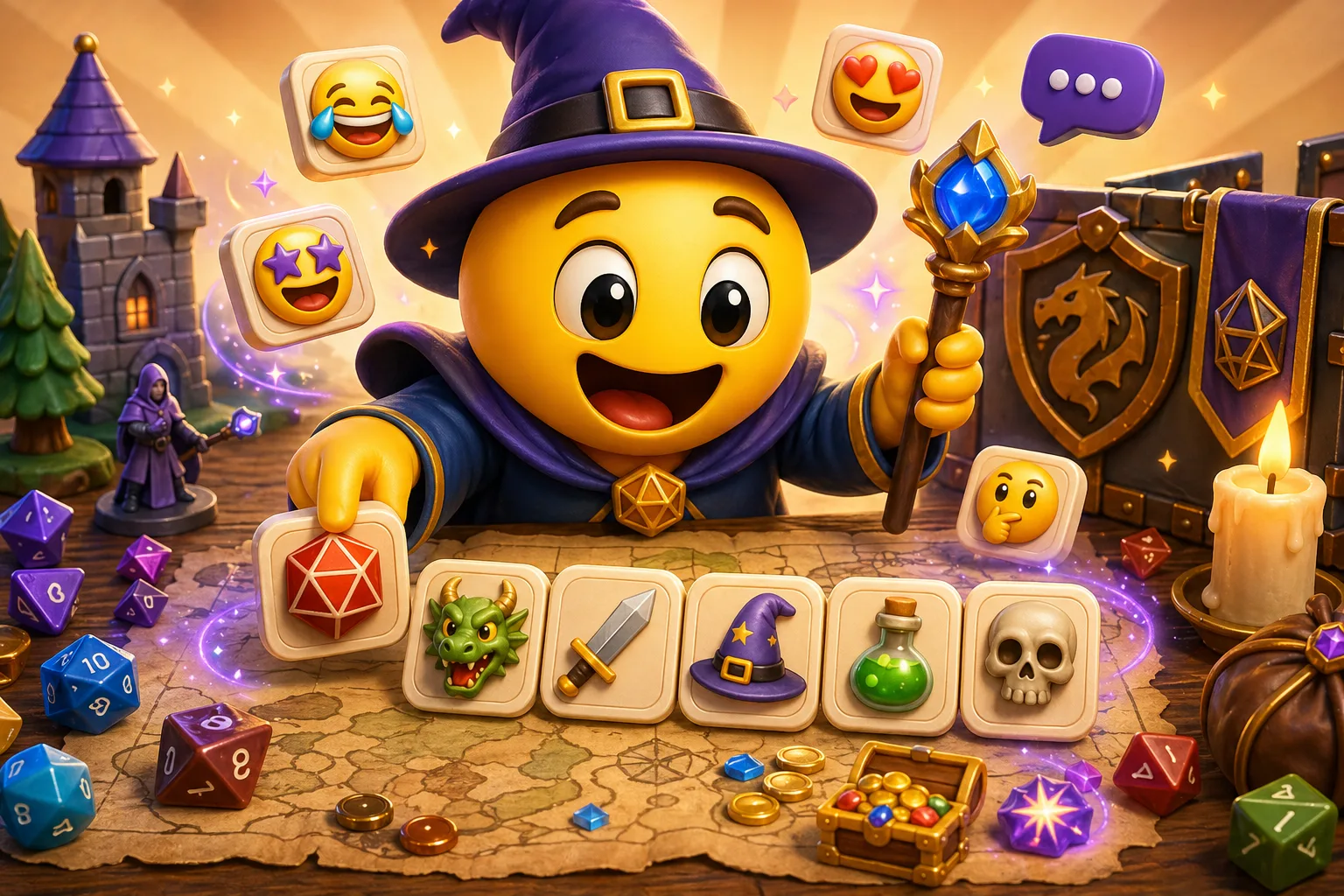
Custom Emojis for D&D and TTRPG Groups
Essential custom emoji ideas for tabletop RPG Discord servers: dice rolls, character stats, spell effects, and more.
Your D&D Discord server lives and dies by how fast people can communicate during combat. Instead of typing "I rolled a 17 for initiative," someone drops an initiative emoji with a 17. Instead of "my character is poisoned and frightened," they react with poison and fear emojis. Custom emojis turn your text channel into a visual game board where everyone can track status at a glance.
Dice roll emojis (start here)
Nat 20 emojis are your most-used emoji by far. Every time someone crits, chat explodes with nat 20 spam. Make it celebratory—dice with sparkles, a 20 with a crown, your campaign logo with "CRIT" plastered on it. If you're going to animate one emoji, make it this one. A spinning d20 landing on 20, an explosion of confetti, dice with rainbow trails. This emoji represents pure hype.
Nat 1 emojis get almost as much use but need a different vibe. It should be funny, not devastating—it's a game and critical fails are entertainment. A d20 on fire, a die with a skull, an "oof" expression on a die face. Your party will spam this whenever someone whiffs spectacularly, and the right emoji turns disaster into comedy.
Beyond the extremes, you have options for other rolls. Some groups make emojis for high rolls (18-19), mid rolls, and low rolls. Others just make individual die face emojis showing numbers 1-20. The first approach is faster to use mid-combat. The second is more versatile but clutters your emoji list. Consider your group's play style—do people call out exact numbers or just "high" vs "low"?
Advantage and disadvantage indicators save tons of typing. A double die or up arrow for advantage, single die or down arrow for disadvantage. People use these when asking "do I have advantage on this?" or announcing their roll. Quick, clear, universally understood.
Character status and condition tracking
Hit point tracking is constant in D&D. Heart emojis in different states work perfectly—full heart for healthy, half heart for bloodied, broken heart for low HP, skull for down. Your healer uses the healing potion emoji when they're about to restore someone. These get posted in combat channels so everyone can see who needs help without asking.
D&D 5e has a dozen conditions that come up constantly, and each one deserves an emoji. Poisoned shows as a skull with green coloring. Stunned is stars or dizzy spirals around a head. Charmed uses heart eyes or hypnotic spirals. Frightened shows a scared face. Paralyzed could be a figure in an ice block. Blinded is covered eyes. Prone is a figure lying down. When the DM says "you're stunned for one round," that player immediately reacts to their message with the stunned emoji, and everyone knows their status without checking notes.
Buffs and debuffs need their own visual language. Inspiration is a light bulb, spark, or bardic d6. Blessed shows a holy symbol or glowing aura. Bane is a dark cloud or downward arrow. Haste uses speed lines or a double figure to show movement. Your players apply these to their own messages when they receive buffs, creating a quick reference for what's active.
Class-specific identity emojis
Every player character should have their class represented. Fighter gets a sword and shield. Wizard gets a pointed hat or spellbook. Rogue gets a dagger or mask. Cleric shows their deity's holy symbol. Ranger has a bow and arrow. Barbarian shows a rage face or greataxe. These aren't just decorative—people use them to indicate who's acting or who has an ability available.
The full list: Paladin gets a sword with holy glow. Warlock shows eldritch blast or their patron's symbol. Druid uses a leaf or wild shape animal. Bard displays a lute or music notes. Monk shows a fist or meditation pose. Sorcerer has wild magic energy or a fireball. If someone multiclasses, you can combine elements or make a hybrid emoji just for them.
These class emojis become shorthand in planning. "Wizard emoji, can you counterspell?" is faster than typing out the character name. "I need fighter emoji and paladin emoji up front" immediately communicates the formation. Your emoji list becomes your party roster.
Spell and ability indicators
The eight schools of magic each deserve an emoji if your campaign has lots of spellcasters. Evocation shows a fireball or lightning bolt. Necromancy is a skull. Illusion uses mirrors or smoke. Enchantment shows swirly eyes. Abjuration displays a protective shield. Conjuration has a summoning circle. Transmutation shows transformation arrows. Divination uses a crystal ball. These help when someone asks "what school is that spell?" or when tracking counterspell options.
Specific spells that get referenced constantly need their own emojis. Fireball is an explosion—you'll use this one every session. Healing Word shows a sound wave with a heart. Shield depicts a magical barrier. Counterspell is an X or cancel symbol. Detect Magic shows an eye with magical aura. Invisibility uses a faded figure outline. These aren't every spell in the game, just the handful your party actually casts repeatedly.
Spell slot tracking can use filled vs empty circle emojis, with different colors for different spell levels. Some groups post their available slots at the start of combat and update them as they cast. Others just announce when they're out of a certain level. Depends on how much your group wants to track publicly vs privately.
Combat flow and turn order emojis
Initiative tracking moves faster with visual markers. When combat starts, everyone rolls and posts their init score with an initiative emoji. The DM sorts them and announces turn order. When it's your turn, you react with a "my turn" emoji so everyone knows you're acting. When you're done, you use an "end turn" emoji or tag the next person. This prevents the constant "whose turn is it?" questions.
Action economy emojis clarify what you've used. A "bonus action used" marker, "reaction available" vs "reaction used" indicators, "ready action" symbols. Not every group tracks this publicly, but for newer players still learning the rules, visual reminders help a lot.
Attack type emojis speed up combat narration. A sword swing for melee attacks, an arrow for ranged, a magic burst for spell attacks, a shield for saving throws. The DM posts the attack type emoji when calling for saves or AC checks, and players immediately know what defense applies.
Campaign-specific content
Important NPCs who show up repeatedly deserve their own emojis. Your BBEG (big bad evil guy) needs a recognizable icon that appears whenever they're mentioned or show up. The friendly innkeeper who the party loves gets an emoji. The quest giver NPC. The rival party. Any character who becomes important to your story gets visual representation.
Locations work the same way. The tavern where you always meet gets a tavern emoji. The dungeon entrance. The city gates. Your campaign's major locations become emoji landmarks. "We're back at tavern emoji" is faster and funnier than typing out "The Prancing Pony" every time.
In-jokes and memorable moments are emoji gold. That time the barbarian tried to seduce the dragon. When the rogue "checked for traps" by walking into them. The running gag about the ranger's pet dying. These become campaign lore immortalized as emojis that your group will spam years later.
DM and player communication shortcuts
DMs need quick signals that don't break immersion. An hourglass emoji means "give me a moment to look something up." A book emoji means "checking the rules." A thinking face means "deciding consequences." Eye emojis mean "everyone roll perception." A dice tower means "roll initiative." These let the DM communicate mechanics without typing paragraphs mid-scene.
Player status emojis handle the practical stuff. AFK for away from keyboard. BRB for bathroom breaks. Food emoji for snack breaks. Thumbs up for ready checks when everyone's back from break. These keep sessions moving without derailing them with "where's Steve?" questions every 10 minutes.
Loot and treasure indicators
Treasure emojis let the DM quickly show what's available. Gold coins for money. A glowing item for magic loot. A bag for mundane treasure. A key, scroll, or artifact for quest items. An empty chest for "you searched but found nothing" moments. Players react with eyes or grabby hands to claim items, turning loot distribution into an emoji conversation.
Item rarity can use D&D's color coding. Common items are white or gray. Uncommon is green. Rare is blue. Very Rare is purple. Legendary is orange or gold. The DM posts loot with the rarity color, and players immediately know what they're looking at without asking "how good is this?"
System-specific considerations
D&D 5e is the most common system, but others have unique mechanics worth emoji-ing. Pathfinder 2e uses a three-action economy, so you need one-action, two-action, and three-action emojis. Hero points get their own icon. The conditions are different from 5e, so you'll need different status emojis.
Call of Cthulhu needs sanity tracking emojis—different stages of mental breakdown, temporary insanity, permanent insanity. Vampire: The Masquerade uses blood pool and humanity meters. Fate uses fate points. Each system has mechanics that benefit from visual representation, so customize your emoji set to match what you're actually playing.
Practical organization tips
Use emoji naming prefixes to keep things organized. Either prefix by system like :dnd_nat20:, :dnd_fireball: or by category like :status_poisoned:, :dice_nat1:. This makes emojis way easier to find while typing. Instead of scrolling through 50 emojis looking for "poisoned," you type :status and all status effects appear.
Keep your art style consistent across all campaign emojis. If you mix realistic dice, cartoon characters, and pixel art spells, it looks messy and unprofessional. Pick one style—whether that's illustrated, pixel art, or photorealistic—and stick with it. Your emoji set should feel cohesive, like it all belongs to the same campaign.
Don't make emojis for every possible situation. Every single spell doesn't need its own emoji. Focus on what your group actually uses and references in chat. After a few sessions, you'll notice which mechanics come up repeatedly—those are your emoji priorities. The rest can stay as typed text.
Your starter emoji set (priority list)
Start with 10-15 emojis maximum. Nat 20, Nat 1, initiative marker, advantage/disadvantage, each PC's class symbol, HP indicator, down/dead status, your main villain's icon, "my turn" indicator, and the DM's "checking rules" emoji. That's your foundation. These cover 90% of what actually happens during a typical session.
After a few sessions, evaluate what's missing. Did people keep typing out a specific condition? Make an emoji for it. Did someone cast the same spell five times? That spell needs an icon. Is there an NPC who shows up constantly? Give them an emoji. Let your emoji set grow organically based on your actual campaign, not based on what you think you might need someday.
Retire unused emojis ruthlessly. If you made an emoji three months ago and it's been used twice, delete it and make room for something that actually matters to your current story. Your emoji limit is finite—use those slots on emojis that enhance gameplay, not collect dust.
The right custom emojis turn your D&D Discord from a wall of text into a visual game board where status, rolls, and actions are instantly clear. Start small, add what you actually use, and let your emoji set evolve with your campaign. Create your D&D emojis here →